
How a Chattanooga Electrician Protects Your Home & Wallet

A breaker that won’t stay on is rarely just an annoyance. It is often the first warning from a panel, circuit, or connection that is running hotter than it should. A qualified Chattanooga electrician finds that heat source before it turns into a fire, a fried appliance, or a much larger repair bill. The so-what for you is simple: small electrical fixes made early cost far less than emergency repairs made late.
Key Point
- Repeated breaker trips are a diagnosis, not a nuisance. Reset once. If it trips again, leave it off and have the circuit checked.
- Pre-1960s Chattanooga homes need a grounding plan, not new three-prong outlets swapped onto two-wire circuits.
- Load capacity comes before new equipment. EV chargers, heat pumps, and hot tubs all need a load calculation before anyone buys a bigger panel.
This post covers the main topics in order. First, why local homes have specific risks. Next, panels, older wiring, and GFCI/AFCI protection. Then costs, lifespans, emergencies, EV chargers, generators, lighting, surge protection, and service areas.
Why Chattanooga Homes Face Specific Electrical Risks
Chattanooga’s housing stock and climate create predictable electrical problems. The region mixes early 1900s houses, mid-century ranches, and fast-growing new subdivisions. Each group fails in its own way. Add humid summers, spring thunderstorms, and winter ice on the plateau, and you get a steady pattern of service calls.

On recent service calls across Chattanooga, the same three issues keep coming up:
- Undersized panels in homes that now run heat pumps, EVs, and home offices
- Ungrounded circuits behind original two-prong outlets
- Storm damage to the service mast, weatherhead, and meter base from falling limbs on hillside lots
If you’ve spent a summer in Chattanooga, you know AC systems run for months without a break. That constant load exposes every loose lug and tired breaker in the panel.
| Local Factor | What It Does to Your System | What to Watch For |
|---|---|---|
| Humidity (summer) | Corrodes outdoor boxes and terminals | GFCIs tripping, rust in exterior boxes |
| Thunderstorms | Voltage spikes, limb strikes on service drops | Dead electronics, bent mast, flickering |
| Plateau ice and wind | Long overhead runs snap or sag | Partial power, dim lights |
| Older housing stock | Ungrounded and aged insulation | Two-prong outlets, warm switch plates |
| New-build growth | Panels sized at code minimum | No room for EV or hot tub circuits |
The national stakes are real. According to the NFPA, electrical fires account for about 13% of home structure fires and 18% of home fire deaths each year. Your next step: walk your home and note any warm plates, buzzing, or burning smells before you call anyone.
Check Also: Fosters Electric Chattanooga TN: Protect Your Home Wiring
Electrical Panel Upgrades: The Heart of Home Safety
Your panel decides how much power your home can safely use. It splits incoming service into branch circuits (individual wire runs that each feed a group of outlets or one appliance). Every breaker is a safety valve. When the panel is old, full, or a known problem brand, those valves stop working reliably.
Our network’s licensed electricians frequently see Federal Pacific Stab-Lok and Zinsco panels in local properties built before the 1980s. Both brands have a history of breakers that fail to trip under overload. That is the worst failure a breaker can have.
Signs Your Panel Needs Attention
- Breakers that trip repeatedly or feel loose in the slot
- Scorch marks, rust, or a hot cover on the panel
- Double-tapped breakers (two wires under one screw) or tandem breakers squeezed in
- No open slots for a new circuit
- A 60-amp or 100-amp service in a home with central AC and electric cooking
Repair vs. Replace: Panel Decisions
| Condition | Repair | Replace | Why |
|---|---|---|---|
| One worn breaker | ✅ | Swap the breaker; panel is sound | |
| Loose or corroded main lug | ✅ | Clean or replace lug if bus is undamaged | |
| Federal Pacific or Zinsco | ✅ | Known breaker reliability problems | |
| Burned bus bar | ✅ | Damage spreads to new breakers | |
| Panel full, adding EV or hot tub | Sometimes | Often | Load calc decides; subpanel may work |
| Panel 40+ years old with rust | ✅ | Moisture damage is not fixable |
A detailed look at options lives on our panel repair and replacement page. Your next step: photograph your panel label and the main breaker rating before requesting a quote.
Wiring in Older Chattanooga Homes
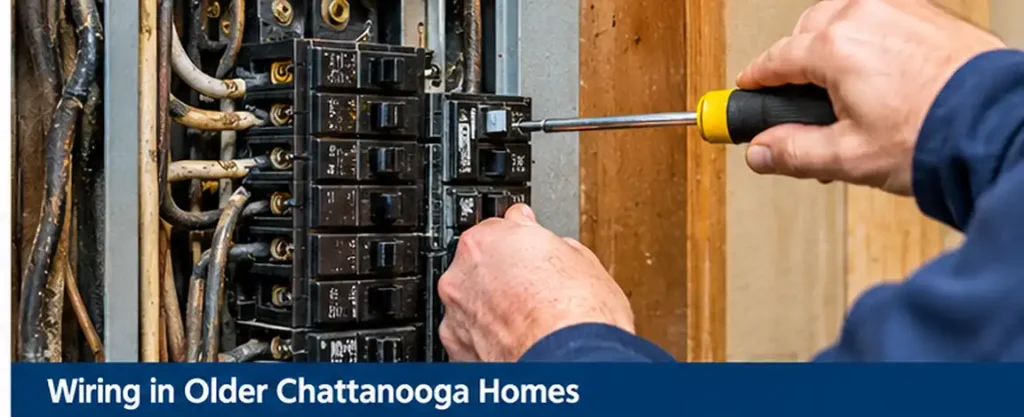
Older wiring is not automatically dangerous, but it is rarely ready for modern loads. Neighborhoods like North Shore, St. Elmo, Highland Park, and Brainerd hold many houses from the early and mid 1900s. Those homes often carry knob-and-tube wiring, cloth-sheathed cable, or ungrounded two-wire circuits.
Knob-and-Tube Wiring
Knob-and-tube (an early system using ceramic knobs and tubes to route single wires) was standard from about 1880 to the 1940s. It has no ground wire. Its insulation turns brittle with age. The biggest risk is decades of amateur splices and attic insulation packed around wires designed to shed heat into open air.
Two-Prong Outlets
Swapping in a three-prong outlet does not add a ground. It only hides the problem. The NEC allows three valid fixes:
- Run a grounding conductor back to the panel or grounding electrode system.
- Install a GFCI outlet and label it “No Equipment Ground.”
- Replace the outlet with another two-prong device.
Older Wiring by Era
| Wiring Type | Typical Era | Ground Wire? | Main Concern | Common Fix |
|---|---|---|---|---|
| Knob-and-tube | 1880s–1940s | No | Brittle insulation, buried in insulation | Phased rewire |
| Cloth-sheathed NM | 1940s–1960s | Often no | Crumbling jacket at boxes | Replace damaged runs |
| Aluminum branch wiring | 1965–1973 | Yes | Loose, overheating terminations | AlumiConn or COPALUM repairs |
| Modern copper NM | 1970s–today | Yes | Overloading, DIY mistakes | Add circuits as needed |
Many homeowners don’t need a full rewire on day one. A phased plan targets kitchens, bathrooms, and bedrooms first. You can browse every residential wiring and safety service to see how projects get grouped. Your next step: count your two-prong outlets and note which rooms have them.
GFCI and AFCI Protection: What Code Requires
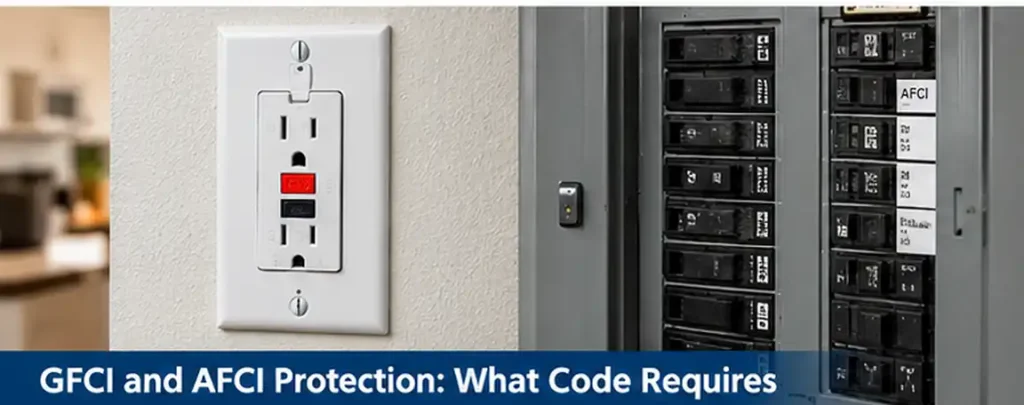
GFCI and AFCI devices protect against two different hazards. A GFCI (ground-fault circuit interrupter) cuts power when current leaks to ground, such as through a person near water. An AFCI (arc-fault circuit interrupter) cuts power when it detects arcing from damaged or loose wires. One prevents shocks; the other prevents fires.
NEC Safety Standards for Homes
| Requirement | NEC Section | Where It Applies | What It Prevents |
|---|---|---|---|
| GFCI protection | 210.8(A) | Bathrooms, kitchens, garages, outdoors, basements, laundry, near sinks | Electrocution |
| AFCI protection | 210.12 | Bedrooms, living areas, kitchens, laundry, hallways | Arc-caused fires |
| Tamper-resistant outlets | 406.12 | Most dwelling receptacles | Child injuries |
| Whole-home surge protection | 230.67 | New and replaced dwelling services | Surge damage |
| Outdoor emergency disconnect | 230.85 | New and replaced dwelling services | First-responder shock risk |
| EV charging circuits | Article 625 | EV supply equipment | Overheating, shock |
| Optional standby generators | Article 702 | Home backup systems | Backfeed onto utility lines |
Local adoption varies. Cities and counties adopt NEC editions on their own schedule. Ask any Chattanooga electrician which code edition your jurisdiction enforces before work begins. That answer shapes what an inspector will require.
GFCI Troubleshooting Steps
- Press RESET on the GFCI once.
- Check other GFCIs in the same area. One device often protects several outlets downstream.
- Unplug everything on the circuit and reset again.
- Leave it off if it trips instantly or trips during rain.
- Call for service if the outlet won’t reset with nothing plugged in.
A GFCI that trips when it rains points to water in an outdoor box or buried cable. Our electrical problem guides explain dozens of symptoms like this one. Your next step: press TEST on every GFCI this month and confirm each one resets.
What Electrical Work Costs in Chattanooga (2026)
Most residential electrical costs fall into predictable ranges. Final prices depend on access, permit fees, panel condition, and wire run length. The ranges below reflect typical 2026 quotes for the region. Treat them as planning numbers, not firm bids.
| Service | Typical Range | Permit Usually Required? |
|---|---|---|
| Diagnostic visit | $100–$250 | No |
| GFCI outlet install | $150–$300 each | Sometimes |
| AFCI breaker install | $100–$250 each | Sometimes |
| Breaker replacement | $150–$400 | Sometimes |
| Panel replacement (same amperage) | $1,800–$4,500 | Yes |
| Service upgrade to 200A | $2,500–$6,500 | Yes |
| Whole-home surge protector | $300–$800 | Often |
| Level 2 EV charger circuit | $800–$2,500 | Yes |
| Generator inlet + interlock | $600–$1,500 | Yes |
| Standby generator with ATS | $8,000–$18,000+ | Yes |
| Whole-home rewire | $10,000–$30,000+ | Yes |
| LED recessed light (per fixture) | $150–$350 | Sometimes |
How to Compare Quotes
- Line up the scope: equipment, circuit count, permit, inspection, drywall patching, cleanup
- Confirm power company coordination for any service upgrade
- Watch for missing permits. A cheaper bid without a permit is not a fair comparison.
- Ask about warranty on both parts and labor
Your next step: request written quotes that list the permit and inspection as separate line items.
Service Lifespans: When to Plan Replacement
Electrical components wear out on a known timeline. Heat, humidity, and repeated surges shorten every number below.
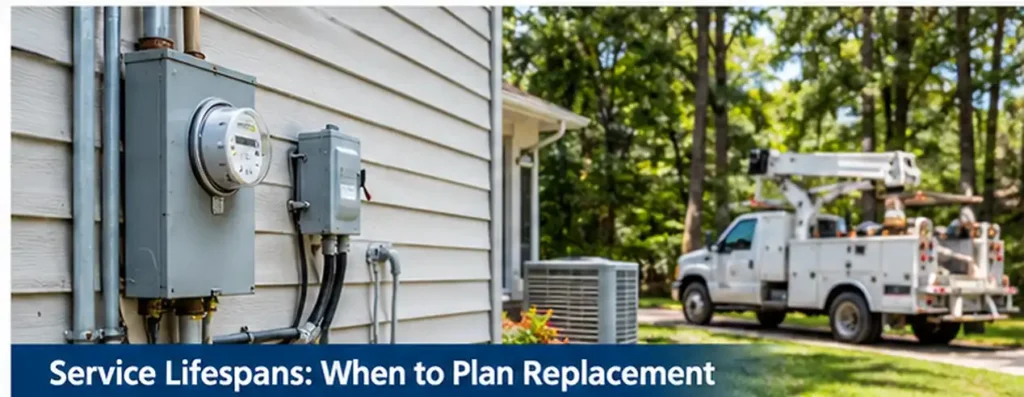
A Chattanooga electrician uses these benchmarks to decide whether a part has years left or months left.
| Component | Typical Lifespan | Shortened By |
|---|---|---|
| Circuit breakers | 30–40 years | Frequent tripping, heat |
| Electrical panel | 25–40 years | Moisture, corrosion |
| GFCI outlets | 10–15 years | Surges, outdoor exposure |
| Smoke alarms | 10 years | Dust, age of sensor |
| Whole-home surge protector | 3–10 years | Number of surges absorbed |
| Standard outlets and switches | 15–25 years | Loose plugs, heavy use |
| Modern copper wiring | 50–70+ years | Overloading, rodents |
| Meter base | 30–50 years | Storm damage, rust |
Your next step: check the date stamp on your smoke alarms and replace any older than 10 years.
Emergency Electrical Service: What to Do First
Some electrical problems cannot wait for a weekday appointment. The USFA estimates 24,200 residential electrical fires each year, causing 295 deaths, 900 injuries, and over $1.2 billion in property loss. Fast action on warning signs prevents most of that damage.
Emergency Signs
- Burning or hot-plastic smell from an outlet, switch, or panel
- Sparks or arcing when you plug something in
- A switch plate or dimmer that is hot to the touch
- Storm damage to the service mast or meter base
- Shocks from fixtures, faucets, or appliances
Emergency Steps
- Get everyone out and call 911 if you see smoke or flames.
- Switch off the affected breaker if you can reach it safely.
- Stay away from downed lines and wet areas.
- Call EPB for problems on the utility side of the meter.
- Call an electrician for damage on your side of the meter.
After-hours availability depends on which local providers are on call that night. Our emergency electrical service page explains what to expect. Your next step: label your panel clearly today so you can kill the right circuit fast.
EV Charger Installation
A Level 2 EV charger needs a dedicated 240-volt circuit sized for continuous load. The NEC treats EV charging as a continuous load, so the circuit must be rated at 125% of the charger’s draw. A 48-amp charger needs a 60-amp circuit. That math stops many panels cold.
| Charger Output | Required Circuit | Approx. Miles Added per Hour |
|---|---|---|
| 16A | 20A | 12–15 |
| 32A | 40A | 25–30 |
| 40A | 50A | 30–35 |
| 48A | 60A | 35–45 |
Pros and Cons of Hardwired vs. Plug-In
- Hardwired pros: higher output, fewer failure points, cleaner install
- Hardwired cons: harder to move or replace
- NEMA 14-50 plug-in pros: portable, easy to swap chargers
- NEMA 14-50 plug-in cons: receptacles can overheat with cheap parts; requires GFCI under recent codes
On recent service calls across Chattanooga, the panel is the bottleneck more often than the charger. A smart load management device can sometimes avoid a full service upgrade. Your next step: note your vehicle’s onboard charger rating before getting a quote.
Generator Hookups for Storm Season
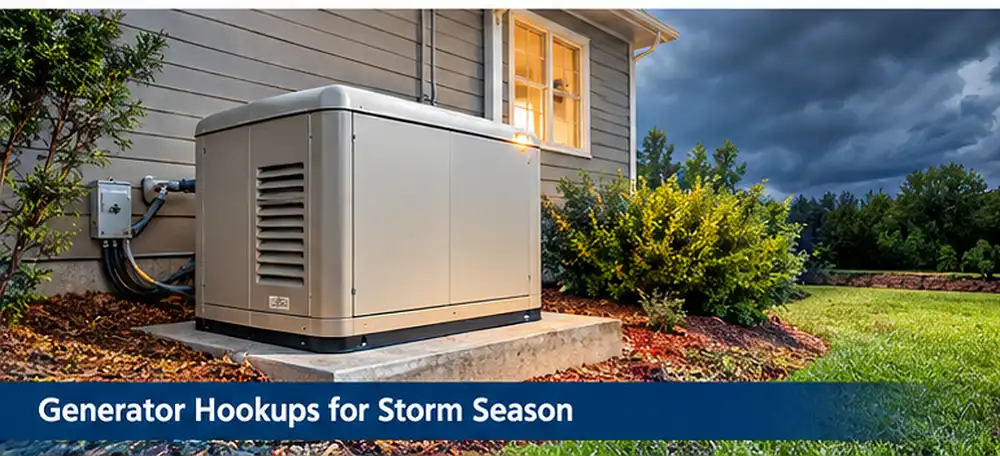
A safe generator connection always uses a transfer switch or interlock. These devices stop backfeed (power flowing from your generator onto utility lines), which can kill line workers. Plugging a generator into a dryer outlet with a “suicide cord” is illegal and deadly.
| Option | Cost Range | Pros | Cons |
|---|---|---|---|
| Portable + inlet + interlock | $600–$1,500 (plus generator) | Affordable, flexible | Manual start, fuel storage |
| Portable + manual transfer switch | $800–$2,000 (plus generator) | Selected circuits only | Limited circuit count |
| Standby + automatic transfer switch | $8,000–$18,000+ | Hands-free, whole-home | Higher cost, gas line needed |
Plateau towns like Monteagle, Altamont, and Tracy City see longer outages from ice and wind. Homes with well pumps need backup power for water, too. Your next step: list the circuits you can’t live without during a three-day outage.
Lighting and Energy-Saving Upgrades
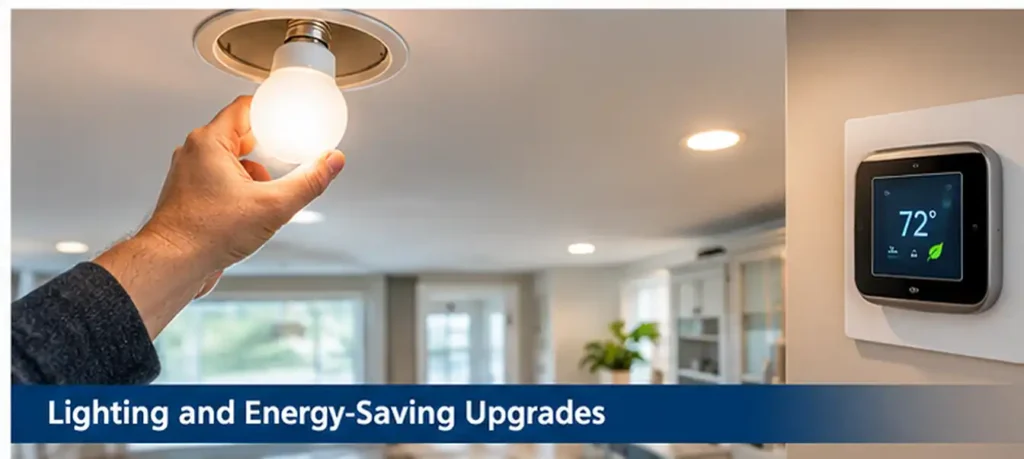
LED lighting cuts lighting energy use by about 75% compared with incandescent bulbs. That figure comes from the U.S. Department of Energy. LEDs also last up to 25 times longer, which matters in tall foyers and hard-to-reach fixtures.
| Upgrade | Energy Impact | Common Issue We See |
|---|---|---|
| LED retrofits | Up to 75% less lighting energy | Flicker with old dimmers |
| LED-compatible dimmers | Smoother control, less waste | Wrong dimmer type for bulb |
| Occupancy sensors | Lights off in empty rooms | Poor placement |
| Smart switches | Scheduling and remote control | Missing neutral wire in older boxes |
| Ceiling fans | Lets you raise thermostat 4°F in summer | Mounted on non-fan-rated boxes |
Hot dimmers and flickering LEDs usually trace back to a mismatched dimmer. Smart switches often need a neutral wire, which many pre-1985 boxes lack. Your next step: check bulb packaging for the dimmer compatibility list before you buy.
Surge Protection for Storm-Prone Homes
Whole-home surge protection works in layers. A Type 2 surge protective device (SPD) at the panel stops large external surges. Plug-in strips at sensitive electronics handle the smaller internal spikes. Neither layer covers what the other one does.
Our network’s electricians frequently see fried HVAC control boards, refrigerators, and garage door openers after summer storms. A modern home holds thousands of dollars in electronics. A panel SPD costs less than one replacement control board.
Surge Protection Checklist
- Install a Type 2 SPD at the main panel
- Use point-of-use protectors on TVs, computers, and routers
- Check the SPD indicator light twice a year
- Replace the SPD after a major nearby lightning strike
- Confirm proper grounding, since an SPD can’t work without it
Your next step: look at your panel for an SPD module and check its status light.
Home Electrical Maintenance Checklist
Routine checks catch most problems before they become repairs. None of these steps involve opening a panel or outlet box. Leave that work to a licensed professional.
Monthly
- Test all GFCI outlets with the TEST and RESET buttons
- Feel switch plates for warmth after heavy use
- Look for scorch marks on outlets and plugs
Every Six Months
- Test smoke and CO alarms
- Check outdoor outlet covers for cracks and water
- Inspect cords for fraying or crushed insulation
Every Year
- Schedule a panel inspection if your home is 25+ years old
- Check the service mast for lean or loose straps after storm season
- Review your panel labels for accuracy
Your next step: put the monthly GFCI test on your phone calendar right now.
Choosing the Right Chattanooga Electrician
The right electrician is licensed, insured, and willing to pull permits. Price alone is a poor filter. A good Chattanooga electrician explains what they found before recommending any work.
Questions to Ask
- Ask for the license number and verify it with the Tennessee Department of Commerce and Insurance.
- Request proof of insurance covering both liability and workers’ comp.
- Confirm who pulls the permit and schedules the inspection.
- Get a written scope with line items.
- Ask about warranty terms on parts and labor.
Georgia homes require a check through the State Construction Industry Licensing Board. Alabama homes use the Alabama Electrical Contractors Board. Your next step: verify any license before signing a quote.
Service Areas Across the Region
Electrical needs change with the terrain. We connect homeowners with independent local electricians in Chattanooga plus 24 nearby communities. Each area brings its own common calls.
| Region | Communities | Common Electrical Needs |
|---|---|---|
| Chattanooga & Hamilton County | Chattanooga, Soddy-Daisy, Apison | Older-home wiring, lake docks, storm readiness |
| Cleveland, Meigs & Rhea | Cleveland, Decatur, Dayton, Spring City | Remodels, EV charging, lake cabins |
| Sequatchie Valley & Marion | Dunlap, Jasper, Kimball, Whitwell | Well pumps, barns, grounding fixes |
| South Cumberland Plateau | Monteagle, Sewanee, Tracy City, Altamont, Beersheba Springs | Generators, ice-damaged masts, surge protection |
| North Georgia | Ringgold, LaFayette, Rocky Face, Tunnel Hill, Resaca, Chatsworth | Panel work, rural service runs, storm repairs |
Lake homes near Chickamauga and Watts Bar need GFCI protection and bonding for docks. Plateau homes sit on long overhead runs that snap in ice storms. Check the full list of communities we cover for your town. Your next step: mention dock, barn, or well pump power when you call so the right specialist responds.
FAQs
How often should I have my home’s electrical system inspected?
Every 3 to 5 years for homes over 25 years old. Inspect before buying, after a major storm, or before a remodel. A Chattanooga electrician can also flag insurance-related concerns like problem panel brands.
Is it safe to keep resetting a breaker?
Reset once. If it trips again right away, leave it off. Repeated resets can hide a fault heating wiring inside the wall.
Do I need a permit for a panel upgrade?
Yes. Panel changes, service upgrades, new circuits, and generator connections almost always need a permit and inspection.
Can I add a hot tub or EV charger without upgrading my panel?
Sometimes. A load calculation decides. Options include a subpanel, a load management device, or a full service upgrade.
What details help an electrician diagnose faster?
Note when it started, which outlets are affected, what was running, and any smells or sounds. Photos of your panel label help too.
Final Word: Small Checks Prevent Big Bills
Electrical safety comes down to catching heat, moisture, and overload early. Here is the short version:
- Repeated trips, warm plates, and burning smells need professional attention fast.
- Older homes need a grounding and rewiring plan, not cosmetic outlet swaps.
- New equipment like EV chargers and generators starts with a load calculation.
- Surge protection and GFCI/AFCI coverage are the cheapest insurance you can buy.
A trusted Chattanooga electrician turns those warning signs into a clear, prioritized plan. Your next step: call (866) 228-4017 with your address and a short description, and you’ll be connected with an independent licensed electrician who serves your part of the region.