
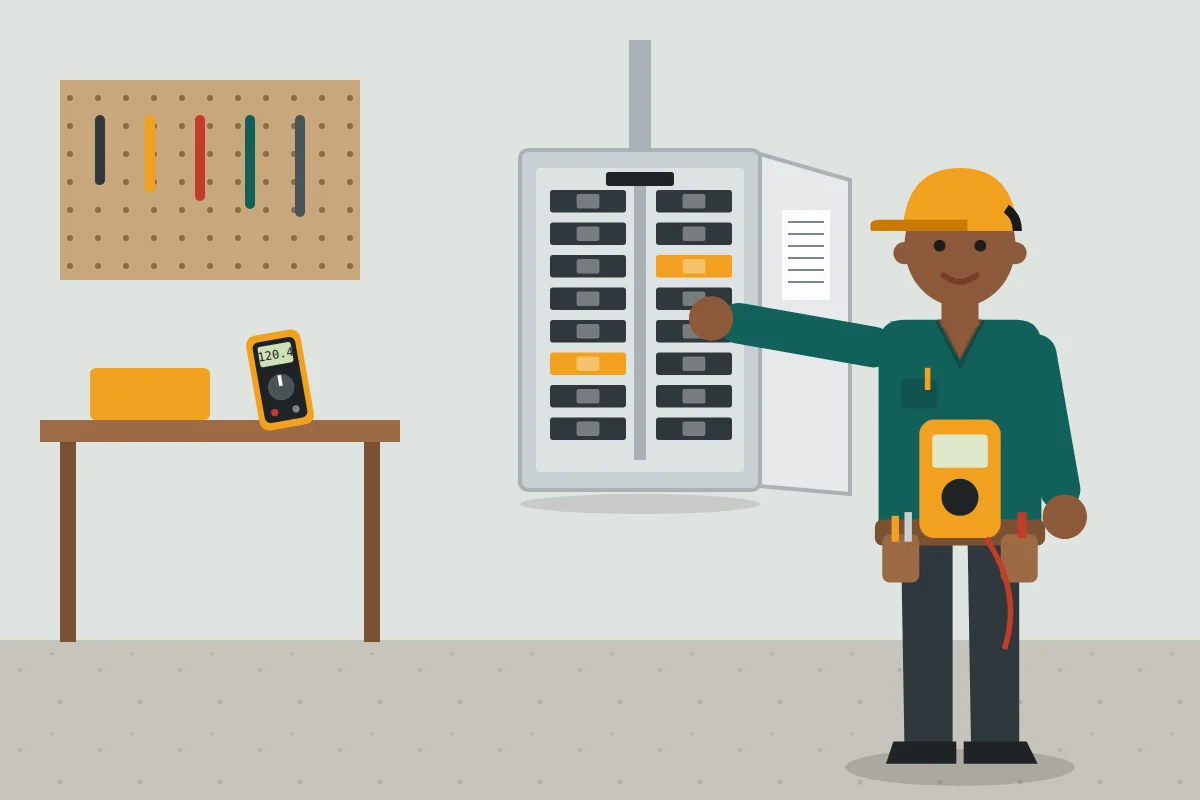
Quick answer: Signs an electrical panel is outdated include a fuse box, a panel that is several decades old, a Federal Pacific (Stab-Lok) or Zinsco brand label, breakers that trip often or will not stay reset, warmth or buzzing at the panel, rust, and a panel so full that new circuits require tandem breakers or cannot be added at all. If any of these apply, have an electrician evaluate the panel. Do not open the panel cover yourself.
The electrical panel is where power from the utility is split into the circuits that run your home. It holds the breakers (or fuses) that shut a circuit off when something goes wrong. When the panel itself is worn out or poorly designed, that protection may not work the way it should.
Many Chattanooga homes still have their original panels, or panels installed during a mid-century update. Some are fine. Others are showing their age or belong to product lines with known concerns. This guide explains the signs electrical panel is outdated, using only what you can see from the outside.
Quick self-check from the outside
Open only the outer door of the panel, the one you would open to flip a breaker. Do not remove screws or the inner cover. Then check these items:
- Fuses instead of breakers.
- A brand label reading Federal Pacific, FPE or Stab-Lok, or Zinsco (sometimes labeled with other names on older units).
- Rust, corrosion or water stains on the box or the wall around it.
- Scorch marks, discoloration or a burning smell.
- A warm surface or a buzzing sound.
- Every slot filled, with some breakers doubled up as thin tandem breakers.
- A circuit directory that is missing, faded or no longer matches the house.
Federal Pacific and Zinsco panels
Federal Pacific Electric panels with Stab-Lok breakers were installed widely in homes from roughly the 1950s through the 1980s. Concerns have been raised for years that some of these breakers may fail to trip under overload, and that breakers can fit loosely on the bus. Zinsco panels, common in the same era, have a reputation for breakers that can overheat or fuse to the bus bar, which can prevent them from shutting off.
Not every one of these panels has failed, and an electrician is the right person to evaluate a specific unit. Still, many electricians and home inspectors recommend replacement when they find one, and some insurers ask about them. If a home inspector flags either brand, take it seriously.
Signs it is running out of capacity
A panel can be in decent condition and still be outdated for the way a household uses power. Capacity signs include breakers that trip when several appliances run, no open spaces for new circuits, and a service size that was set when the home had gas heat and no central air.
This often comes up when homeowners plan an EV charger, heat pump, hot tub or kitchen remodel. The problem page on running out of breaker space explains the options, which may include a larger panel, a subpanel or a service upgrade.
What replacement usually involves
Panel replacement is not a homeowner project. It requires coordination with the utility to disconnect and reconnect power, and it typically requires a permit and inspection. The general sequence looks like this:
Evaluation
The electrician looks at the panel, the service entrance, grounding and the circuits feeding the house, and may run a load calculation.
Planning
Panel size, location, circuit count and any needed AFCI or GFCI protection are decided, along with any meter base or service changes.
Permit and scheduling
The electrician pulls the permit and arranges a disconnect with the utility.
Installation and inspection
Power is off for part of a day while circuits are moved to the new panel, then the work is inspected by the local authority.
Cost depends on factors such as panel size, whether the service or meter base must also change, how much circuit cleanup is needed, required protection devices and local permit requirements.
Storms, surges and the panel
Chattanooga's spring and fall storms bring lightning and outages, and fallen limbs can damage service drops and meter bases. After a hard storm, a quick outside look at the panel and meter area is worthwhile. A panel replacement is also a natural time to discuss whole-home surge protection, since many surge devices mount at or near the panel.