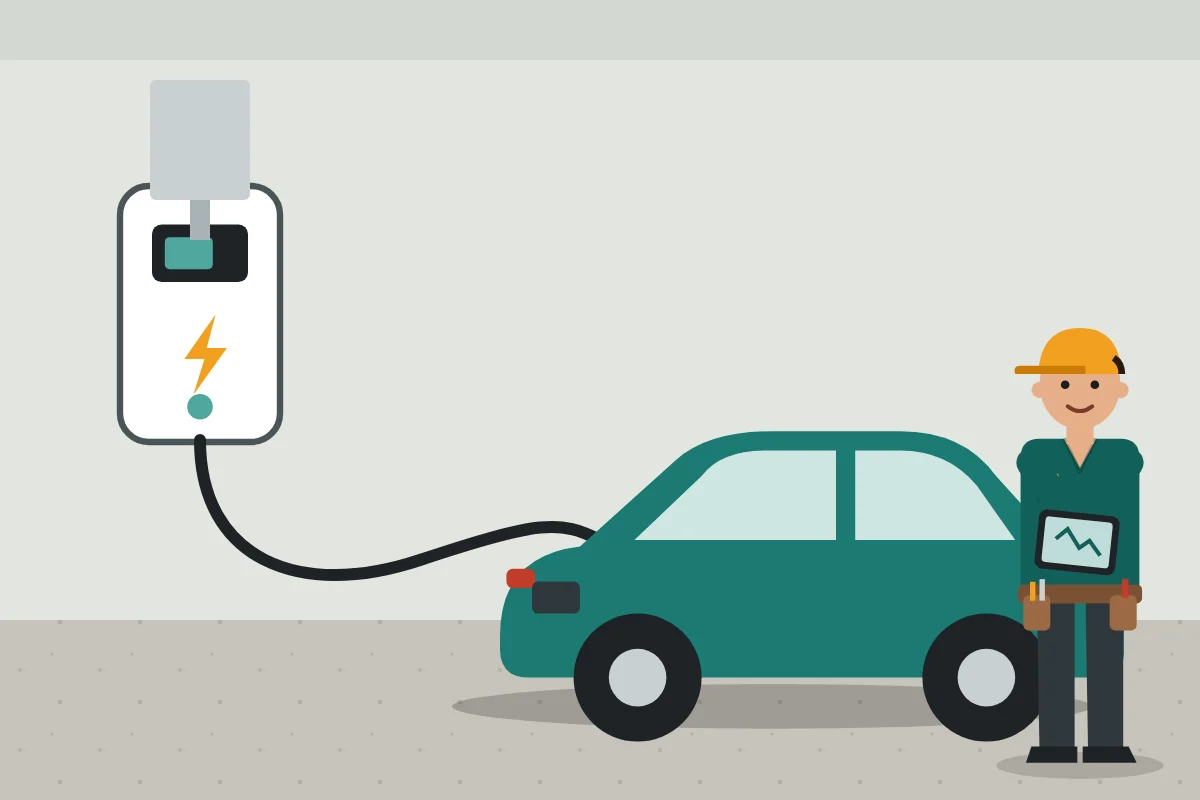
Quick answer: Level 1 charging uses an ordinary 120 V household outlet and needs no special wiring, though it charges slowly. Level 2 charging needs a dedicated 240 V circuit sized for the charger, with wiring, breaker and receptacle or hardwired connection to match. Before installation, an electrician should run a load calculation to confirm the home's service and panel can handle the added demand.
Electric vehicles have become a common sight in Chattanooga driveways, and most owners do the bulk of their charging at home overnight. The first question is usually which charger to buy. The more important question is what your home's electrical system can safely support.
This guide explains the two levels of home charging, what a dedicated circuit means in practice and how an electrician decides whether your panel and service have room.
Level 1 and Level 2 at a glance
- Level 1 uses a standard 120 V receptacle and the cord that often comes with the vehicle. It adds only a few miles of range per hour, which may be enough for short daily commutes or plug-in hybrids.
- Level 2 uses a 240 V circuit, similar to a dryer or range, and charges several times faster. It suits longer commutes, larger batteries and households with more than one EV.
- Even Level 1 charging should use a properly installed outlet on a circuit that is not overloaded by other garage loads.
Many owners start with Level 1 and move to Level 2 later. Planning ahead, even if you are not ready yet, can make the eventual upgrade simpler.
What a dedicated 240 V circuit involves
A Level 2 charger draws a steady, high load for hours at a time. Current electrical code treats that as a continuous load, which means the circuit must be sized with extra capacity beyond the charger's rated draw.
- A two-pole breaker in the panel sized to the charger's requirements.
- Conductors of the correct size and type for the breaker and the distance to the parking spot.
- Either a hardwired connection or a heavy-duty 240 V receptacle rated for the charger.
- Any required GFCI protection, which depends on the equipment and installation method.
- A suitable mounting location that keeps the cord out of the way and protected from vehicle contact.
Why the load calculation comes first
Your home's electrical service has a fixed capacity. Heat pumps, electric water heaters, ranges, dryers and, in some homes, well pumps and shop equipment all draw from it. A load calculation adds up the home's expected demand, following methods in the National Electrical Code, to see how much room is left.
If the numbers work, the charger can be added directly. If they are tight, there are options short of a full service upgrade, such as choosing a lower charging setting or using a load management device that limits charging when other big appliances run. If there is simply not enough capacity, an electrical service upgrade may be needed, which can involve the utility and a permit.
Garage, driveway and panel location
Distance and route affect both cost factors and design. A garage that shares a wall with the panel is straightforward. A detached garage, a carport or a driveway spot far from the panel may need a longer run, trenching or a subpanel.
- Panel space: an older or full panel may have no room for a two-pole breaker.
- Outdoor locations need equipment and connections rated for wet conditions.
- Cord reach: plan for the charge port side of the current vehicle and any future one.
- Older homes may have panels or wiring that should be evaluated before any new large load.
If the panel is already crowded, the page on running out of breaker space explains what electricians typically consider.
Steps from idea to installation
Gather details
Note the charger's specifications, the vehicle's charging rate, panel size and where you park.
Get an evaluation
An electrician inspects the panel, runs a load calculation and plans the circuit route.
Permit and installation
Many jurisdictions require a permit; the electrician installs the circuit and equipment.
Inspection and testing
After any required inspection, the charger is tested under load before regular use.
Safety reminders
Do not use household extension cords for EV charging, and do not use adapters to plug into receptacles that were not designed for the charger. If the charger plug, receptacle or cord feels hot, shows discoloration or smells like melting plastic, stop charging and call an electrician. If you see smoke or flames, leave the garage and call 911. A charger that keeps tripping its breaker is a warning sign worth investigating; an EV charger that trips the breaker covers common causes. When you are ready, a local electrician offering home EV charger installation can plan the circuit.