
Lights Flicker When Appliance Turns On: What It Means
Your kitchen lights dip each time the refrigerator compressor starts. The ceiling fixture blinks when the washing machine begins its spin cycle. When lights flicker when appliance turns on, your home’s wiring is showing you how it handles a sudden demand for power. A brief, faint dim is often normal physics. A deep, repeated, or worsening flicker can point to a loose connection, an overloaded circuit, or a panel that has reached its limit.
The practical point is safety and cost. Loose connections create heat. Overloaded circuits wear out breakers. Undersized service limits every upgrade you plan, from a heat pump to an EV charger. This guide shows how to tell the harmless flicker from the warning sign and what to do about each.
Key Takeaways
- The test is the size of the dip and how long it lasts. A faint dim under one second when a large motor starts is typical. A dip that is deep, lasts longer, or happens across several rooms needs an electrician’s meter.
- Shared circuits cause most appliance-triggered flicker. A washer, microwave, or window AC on the same circuit as your lights pulls voltage away from them at startup. A dedicated circuit usually ends the problem.
- Whole-house flicker points upstream. If every room dims together, the cause is usually at the panel, meter base, neutral connection, or utility service drop, and it should be checked within days, not months.
What Causes Lights to Flicker When Appliances Start?
Appliance-triggered flicker comes from a short burst of current. Motors and compressors need far more power to start than to run. This startup surge is called inrush current (the brief spike drawn when a motor begins turning). For a fraction of a second, the appliance takes a larger share of the available voltage, and your lights get less.
The flicker you see depends on three things: how big the surge is, how much resistance sits in the wiring, and whether the lights share a path with the appliance. Every home wire has some resistance, so some dimming is unavoidable. Problems start when resistance is higher than it should be.
The Six Most Common Causes
- Shared branch circuit. The lights and appliance draw from the same breaker and wire.
- Loose or worn connection. A slack terminal at a receptacle, switch, splice, or breaker adds resistance.
- Overloaded circuit. Too many devices on one breaker push the wire near its limit.
- Long or undersized wire runs. Long runs of 14-gauge wire to a detached garage or far bedroom lose more voltage.
- Loose service neutral. A failing neutral at the panel or meter causes some circuits to dim while others brighten. This one is a genuine hazard.
- Undersized electrical service. An older 60-amp or 100-amp service can strain under modern loads.
On service calls across Chattanooga, the local electricians we connect homeowners with find that shared circuits and loose connections account for most of these complaints. The fix is usually targeted, not a full rewire.
Next step: Note which lights flicker and which appliance triggers them before you call anyone. That single detail cuts diagnostic time.
Voltage Drop Explained in Plain Language
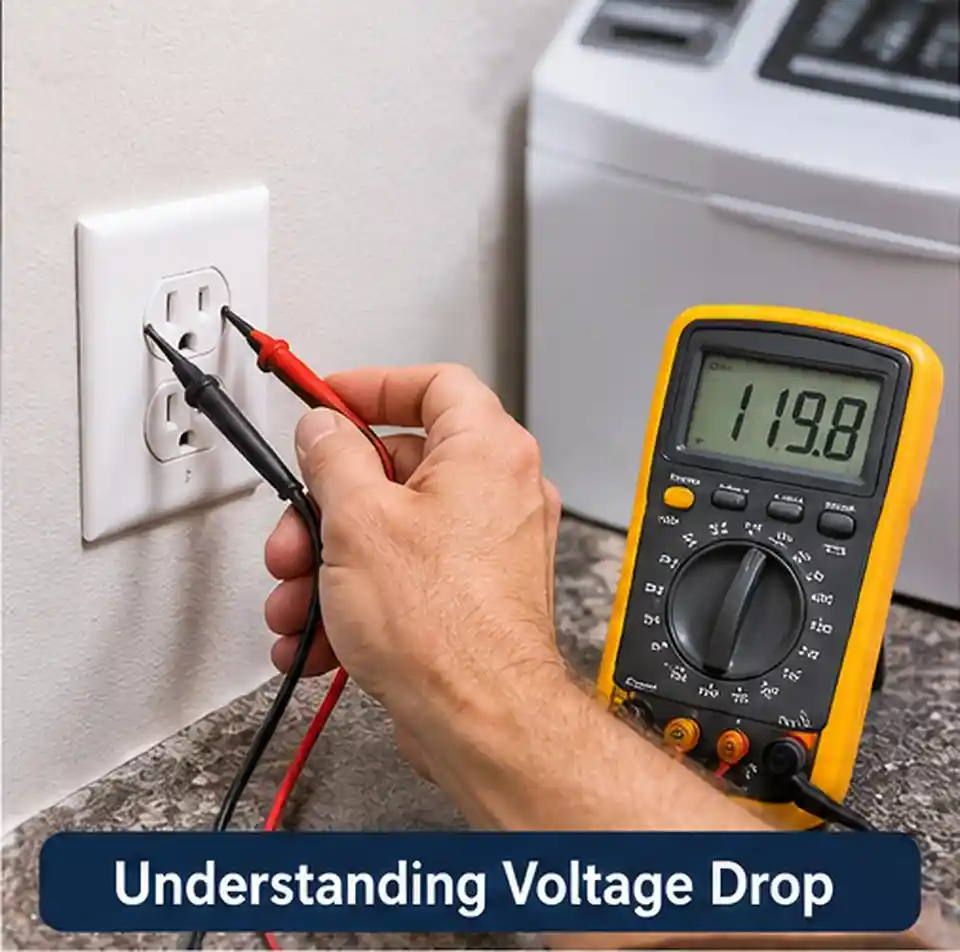
Voltage drop is the voltage lost as current travels through wire. Think of a garden hose. The longer and narrower the hose, the weaker the stream at the end. Wire works the same way: longer runs, thinner gauge, and more current all lower the voltage that reaches your fixture.
Your home receives about 120 volts on each standard circuit. The national standard for utility delivery (ANSI C84.1) treats roughly 114 to 126 volts as the normal service range. A motor starting on a shared circuit can briefly pull a fixture several volts below that. Your eyes notice the dip even when the numbers stay inside safe limits.
| Voltage Reading at Fixture | What You Typically See | What It Usually Means |
|---|---|---|
| 118 to 124 V, steady | No visible flicker | Healthy circuit |
| Brief dip of 2 to 4 V at startup | Faint blink, under 1 second | Normal motor inrush on a shared circuit |
| Dip of 5 to 10 V at startup | Noticeable dim, every cycle | Overloaded circuit, long run, or added resistance |
| Dip over 10 V or lasting several seconds | Strong dim, sometimes in multiple rooms | Loose connection, panel issue, or service problem |
| Some lights dim, others brighten | Uneven brightness across rooms | Possible loose neutral: call promptly |
The National Electrical Code (NFPA 70) includes informational notes recommending no more than 3% voltage drop on a branch circuit and 5% total from service to outlet. Those are design targets, not mandatory rules. They give electricians a clear yardstick when they measure your circuits under load.
Next step: If you own a plug-in voltage meter, record a reading at a nearby outlet before and during appliance startup. Share those numbers with your electrician.
Appliance-Specific Causes
Each large appliance creates its own flicker pattern. Knowing the pattern helps narrow the cause fast. The table below shows typical running current compared with startup current for common household loads. Actual figures vary by brand, age, and model.
Appliance Startup Current Draw
| Appliance | Typical Running Current | Typical Startup (Inrush) Current | Circuit Commonly Required |
|---|---|---|---|
| Washing machine (120 V) | 5 to 10 A | 2 to 3 times running, briefly | 20 A circuit, ideally dedicated |
| Refrigerator (120 V) | 3 to 6 A | 3 to 6 times running | 15 or 20 A, often dedicated |
| Microwave (120 V) | 10 to 13 A | Short spike at magnetron start | 20 A dedicated (built-in units) |
| Window AC (120 V) | 5 to 12 A | 3 to 6 times running | 15 or 20 A, often dedicated |
| Central AC / heat pump (240 V) | 15 to 30 A | Locked-rotor amps often 60 to 130 A | Dedicated 240 V circuit |
| Electric dryer (240 V) | 20 to 25 A | Heating element plus drum motor | 30 A dedicated 240 V |
| Well pump (240 V) | 8 to 12 A | 4 to 6 times running | Dedicated 240 V circuit |
| Shop vac or table saw | 8 to 15 A | High, very brief | 20 A, garage or shop circuit |
Washing Machine
A washer triggers flicker at fill, agitation, and spin. The motor restarts several times per cycle, so the dim repeats. When lights flicker when appliance turns on washing machine cycles begin, the cause is usually a laundry circuit shared with nearby lights or a hallway receptacle. Code calls for a 20-amp laundry circuit. In older Chattanooga homes, that circuit sometimes feeds far more than the laundry room.
Central AC and Heat Pump
The outdoor compressor draws the largest startup surge in most homes. A whole-house dim when the AC kicks on is common in summer. If the dim is getting worse each year, the compressor’s start capacitor may be weakening. A failing capacitor makes the compressor struggle longer, which stretches the dim. An HVAC technician can test it, and a hard-start kit or soft starter can shorten the surge.
Dryer
A dryer runs on 240 volts and its own breaker. Lights should not flicker much when it starts. If they do, look at the panel connections and the service neutral, because a healthy dedicated 240 V circuit rarely affects lighting circuits.
Microwave
A microwave pulls 10 to 13 amps the moment it starts heating. Countertop units often share a kitchen circuit with under-cabinet lights or a coffee maker. That stacking pushes the circuit near its 20-amp limit, and the lights show it.
Next step: Run each large appliance one at a time and watch the lights. The appliance that causes the deepest dim is your starting point.
LED vs. Incandescent Flickering: Why the Bulb Matters
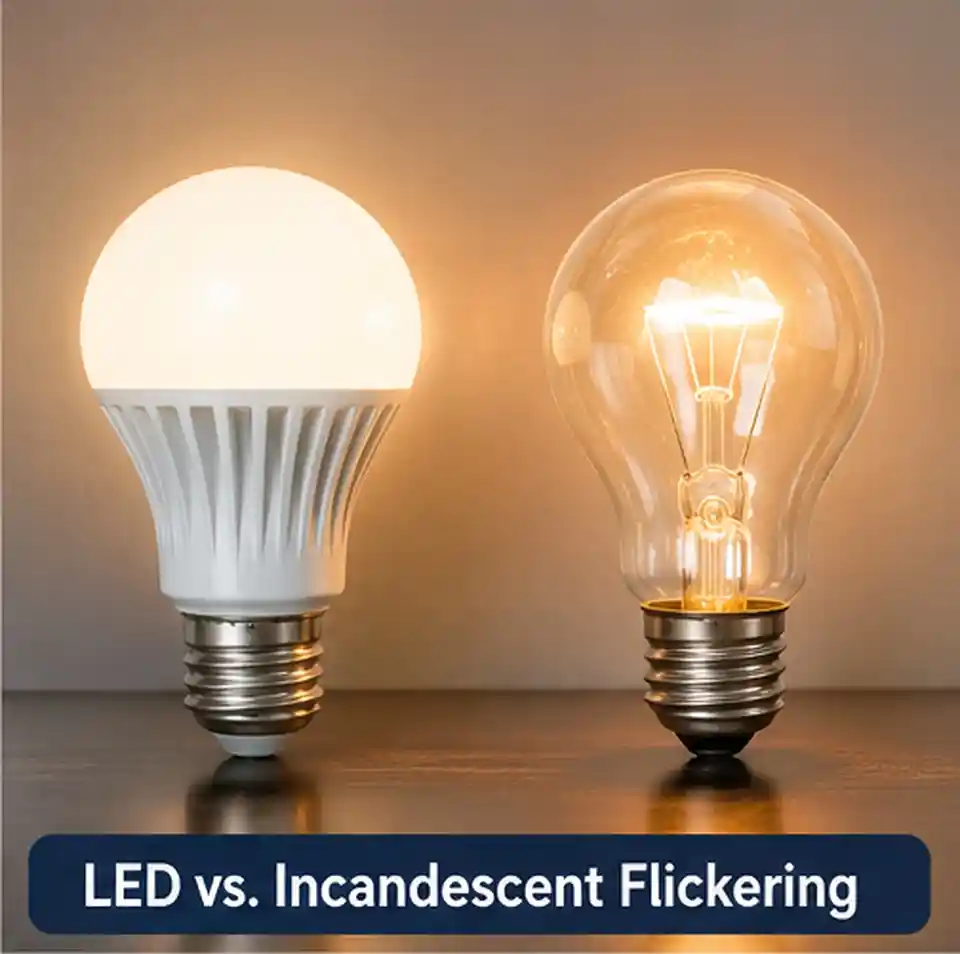
LED bulbs react to voltage changes differently than incandescent bulbs. An incandescent filament stays hot for a split second, which smooths out a brief dip. An LED has no thermal buffer. Its driver (the small circuit inside the bulb that converts AC power for the diodes) responds almost instantly to voltage changes.
That is why LED lights flicker when appliance turns on events that older bulbs barely showed. The bulb is not always the problem. Sometimes the LED is simply more honest about what your wiring is doing.
| Factor | Incandescent | LED |
|---|---|---|
| Response to voltage dip | Slow fade, often invisible | Instant blink or strobe |
| Dimmer compatibility | Works with nearly any dimmer | Needs an LED-rated dimmer |
| Flicker from cheap drivers | Not applicable | Common with low-cost bulbs |
| Energy use | High | Up to 75% to 90% less |
| Lifespan | About 1,000 hours | About 15,000 to 25,000 hours |
The U.S. Department of Energy’s Energy Saver resources outline why LEDs remain the efficient choice. The answer is to match them with quality drivers and compatible controls, not to go back to incandescent bulbs.
Quick LED Checks
- Swap in a name-brand bulb from a different product line and test again.
- Check the dimmer label for LED compatibility and minimum load ratings.
- Avoid mixing LED and incandescent bulbs on one dimmer.
- Test without the dimmer by using a standard switch circuit, if available.
If ceiling lights flicker when appliance turns on and they sit on an older dimmer, the dimmer is often the weak link. A local electrician can match controls to your fixtures through our lighting and dimmer control services.
Next step: Replace one flickering LED with a higher-quality bulb before calling for service. If the flicker stays, the cause is in the wiring.
When Flickering Is Normal vs. a Warning Sign
A small, brief dim at motor startup is normal. Flicker becomes a warning sign when it changes, spreads, or comes with heat, smell, or sound. Use the two lists below to sort your situation.
Usually Normal
- A faint dim lasting under one second
- Only one circuit affected, near the appliance
- Same intensity for months or years
- Happens only when a large motor starts
Warning Signs
- Dimming lasts several seconds or pulses repeatedly
- Lights in several rooms dim together, or some get brighter
- Flicker is getting worse over weeks
- Warm switch plates, receptacles, or breaker panel covers
- Buzzing or crackling at a switch, outlet, or panel
- Burning or hot-plastic smell
- Breakers tripping when the same appliance runs
- Appliances failing early or electronics resetting
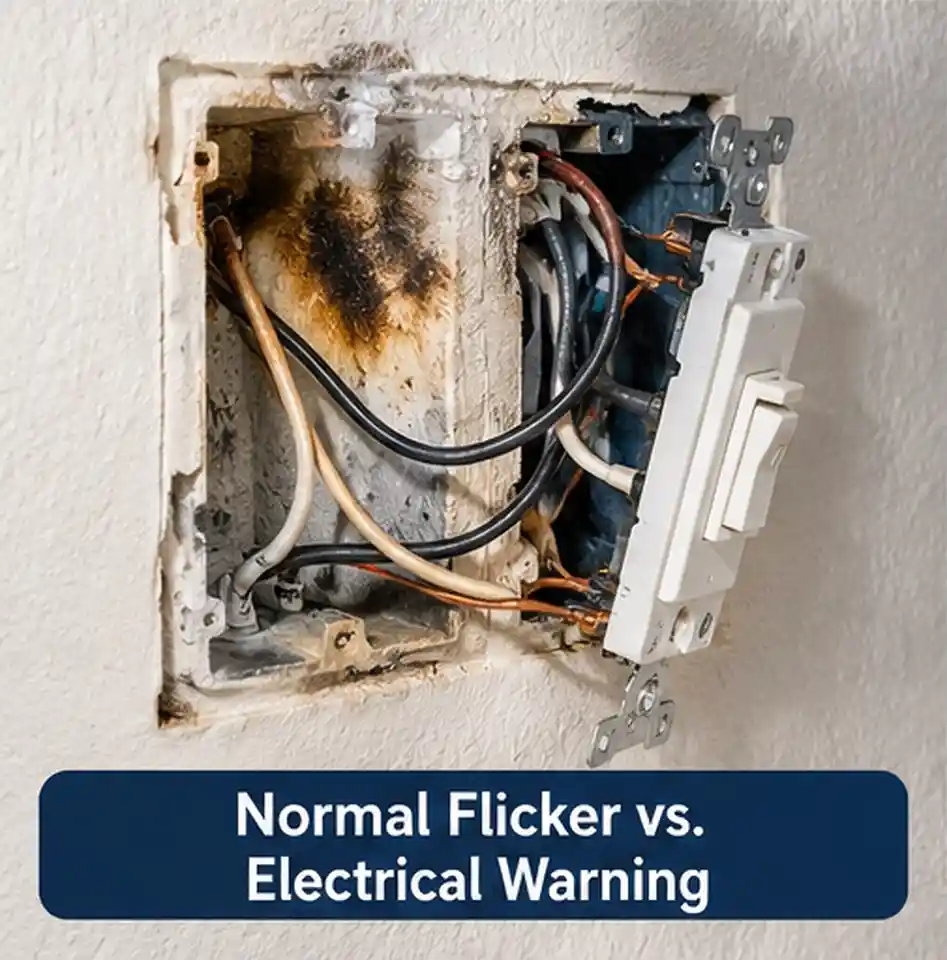
Lights that get brighter while others dim are a classic loose-neutral sign. That condition can send excess voltage to devices and damage them. It also creates heat at the failed connection.
If you smell burning or see smoke, leave the house and call 911. For non-fire hazards, switch off the affected circuit if you can do it safely and request emergency electrical service.
Next step: Mark each item from the warning list that applies to your home. Two or more means you should schedule a diagnostic visit this week.
NEC and Safety Standards That Apply
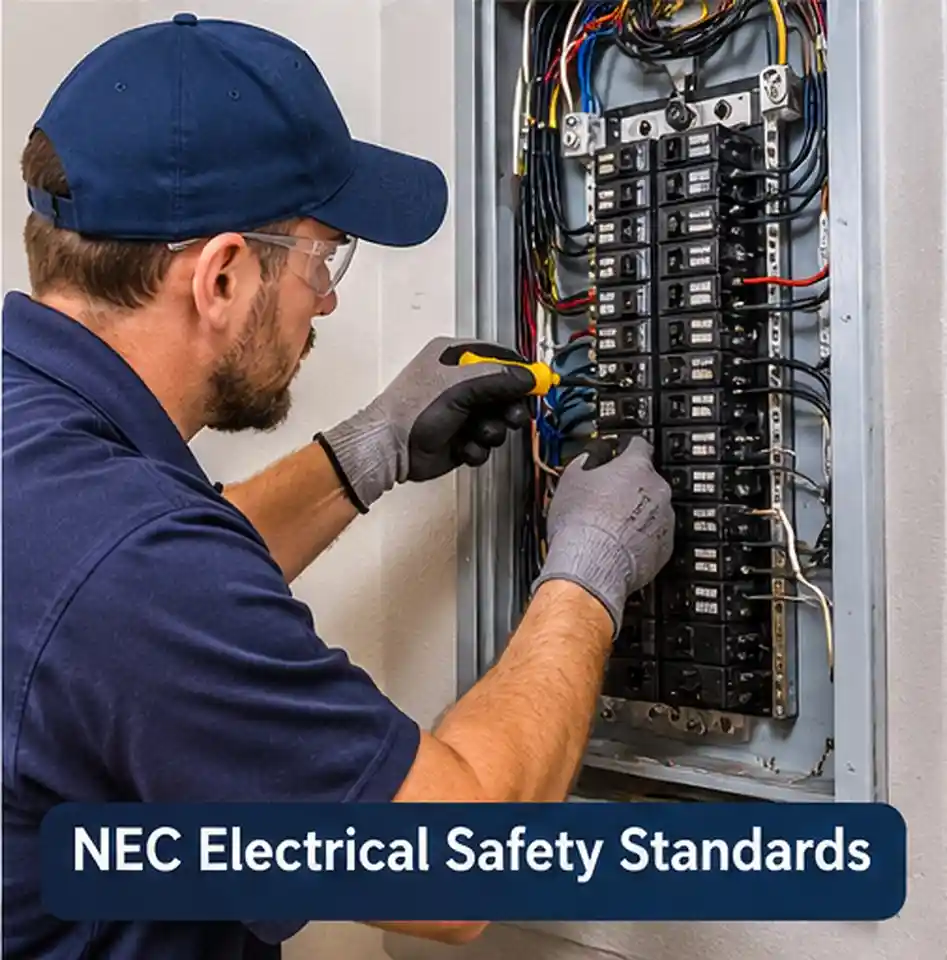
The National Electrical Code sets the baseline for safe residential wiring. The current edition is NFPA 70, 2026. Local jurisdictions adopt specific editions on their own schedule, so your city or county may enforce an earlier one. Your electrician should confirm which edition applies at your address.
| Standard or Requirement | What It Covers | Why It Matters for Flicker |
|---|---|---|
| 20 A laundry circuit (NEC 210.11(C)(2)) | At least one 20 A circuit for laundry receptacles | Stops washers from sharing with lights |
| Two 20 A small-appliance circuits (NEC 210.11(C)(1)) | Kitchen countertop receptacles | Spreads microwave and toaster loads |
| Voltage drop guidance (NEC 210.19 informational note) | Recommends 3% branch, 5% total | Gives a measurable flicker threshold |
| Conductor ampacity (NEC 310) | Wire size matched to breaker size | Undersized wire overheats and drops voltage |
| Terminal torque (NEC 110.14(D)) | Connections tightened to manufacturer specs | Loose terminals are a leading flicker cause |
| AFCI protection (NEC 210.12) | Arc-fault breakers in living areas | Detects dangerous arcing at bad connections |
| Load calculation (NEC Article 220) | Sizing service for total home demand | Shows whether your panel can carry new loads |
| ANSI C84.1 | Utility voltage delivery range | Defines normal 114 to 126 V service |
Torque specs deserve attention. Since the 2017 edition, the NEC has required connections to be tightened with a calibrated torque tool where the manufacturer provides a value. That rule exists because loose lugs cause real fires.
Next step: Ask any electrician you hire whether they torque-check panel connections during diagnostic work.
Troubleshooting Checklist You Can Do Safely
You can narrow the cause without opening any electrical box. These steps involve observation only. Do not remove cover plates or the panel dead front.
- Identify the trigger. Turn on one appliance at a time and note which one causes the flicker.
- Map the affected lights. Walk the house and list every fixture that dims.
- Check the breaker labels. See whether the appliance and the lights share a breaker.
- Swap the bulb. Replace one flickering LED with a quality bulb from another brand.
- Remove extra loads. Unplug space heaters, hair dryers, or extension-cord setups on the same circuit.
- Feel the cover plates. A warm switch or outlet plate near the flicker is a red flag.
- Ask your neighbors. If nearby homes also flicker, the cause may be on the utility side.
- Write it down. Record the time, appliance, rooms affected, and how long each dim lasts.
When to Stop and Call
- You smell burning or hear buzzing
- A breaker trips repeatedly
- Multiple rooms dim together
- The flicker worsens after you remove extra loads
Persistent flicker with no obvious trigger needs proper electrical troubleshooting. A licensed electrician uses a voltage meter under load, infrared thermal checks, and torque testing to find the exact connection or circuit at fault.
Next step: Bring your written notes to the first call. Electricians diagnose faster when they know the pattern.
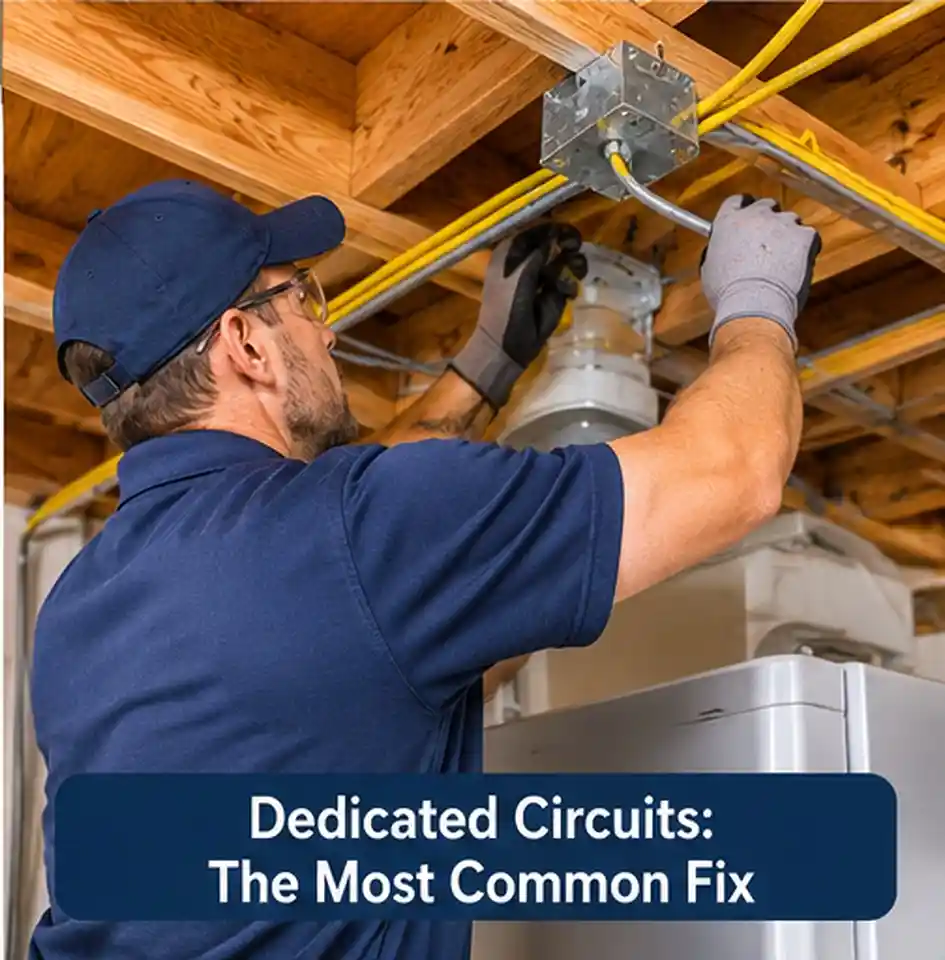
Dedicated Circuits: The Most Common Permanent Fix
A dedicated circuit serves one appliance and nothing else. It has its own breaker and its own wire run from the panel. When the appliance starts, its surge stays on that circuit instead of pulling voltage from your lights.
Our network’s electricians frequently see this in local properties: a 1960s or 1970s ranch where one 20-amp circuit feeds the washer, a hallway light, two bedroom receptacles, and a bathroom fan. That layout made sense when the house was built. It does not hold up to modern front-load washers and multiple LED fixtures.
Appliances That Benefit Most
- Refrigerators and standalone freezers
- Washing machines
- Built-in and over-range microwaves
- Window or through-wall AC units
- Dishwashers and garbage disposals
- Well pumps and sump pumps
- Garage and shop power tools
Pros and Cons
Pros
- Ends shared-circuit flicker in most cases
- Reduces nuisance tripping
- Lowers heat on existing wiring
- Meets current code for many appliances
Cons
- Requires panel space for a new breaker
- Wall or ceiling access may be needed for the wire run
- Permit and inspection often required
Local electricians install these through our dedicated appliance circuits service, and they can add or correct receptacles and runs through broader home wiring work.
Next step: List every large appliance that shares a breaker with lights. That list becomes the scope for your quote.
Panel Capacity Issues
Your panel sets the ceiling for everything your home can run at once. If the panel is undersized, worn, or full, flicker can spread across the whole house. Adding a heat pump, EV charger, hot tub, or induction range makes the problem worse.
Panel Warning Signs
- Whole-house dimming when the AC or dryer starts
- Breakers that feel warm or look discolored
- No open slots for new circuits
- Tandem breakers squeezed in to make room
- Panel brand concerns such as older Federal Pacific or Zinsco models
- Rust or moisture inside the panel enclosure
A full panel is not automatically unsafe, but a crowded one hides problems. An electrician runs an NEC Article 220 load calculation to see whether your service can support current and planned loads.
| Service Size | Typical Home Profile | Flicker Risk With Modern Loads |
|---|---|---|
| 60 A | Pre-1960 homes, original service | High: rarely adequate today |
| 100 A | 1960s to 1980s homes | Moderate to high with central AC plus electric appliances |
| 150 A | Some 1990s and newer homes | Low to moderate |
| 200 A | Most new construction | Low for typical households |
| 320/400 A | Large homes, EV plus all-electric | Very low |
Worn or problem panels can be handled through electrical panel repair and replacement. When the load calculation shows you need more capacity, an electrical service upgrade is coordinated with EPB or your local utility.
Next step: Find your main breaker and note its amp rating. That number tells you where your home stands in the table above.
Repair vs. Replace: Making the Right Call
Most flicker problems need a repair, not a replacement. The table below compares common fixes against larger upgrades so you can match the solution to the cause.
| Situation | Repair Option | Replace or Upgrade Option | Typical Recommendation |
|---|---|---|---|
| Loose receptacle or switch | Tighten or replace device | Not needed | Repair |
| Loose breaker connection | Re-terminate and torque | Replace breaker if damaged | Repair, replace breaker if pitted |
| Shared appliance circuit | Rebalance loads | Add dedicated circuit | Add circuit |
| Weak AC compressor start | Replace capacitor | Add hard-start kit or soft starter | Repair first |
| Incompatible LED dimmer | Swap bulbs | Replace with LED-rated dimmer | Replace dimmer |
| Loose service neutral | Utility or electrician repair at connection | Replace meter base if corroded | Repair urgently |
| Old or recalled panel | Limited | Panel replacement | Replace |
| Undersized service | Load management device | Service upgrade | Upgrade if adding major loads |
| Aluminum branch wiring | COPALUM or AlumiConn repairs | Partial or full rewire | Repair at connections, plan long term |
| Knob-and-tube wiring | Limited | Phased rewiring | Replace over time |
Individual breakers that run hot or loose are addressed through circuit breaker services. Smaller fixes at switches, fixtures, and outlets fall under general electrical repair.
Next step: Ask for a written explanation of why a replacement is needed if one is recommended. A good electrician shows the reading or the damaged part.
Cost Comparison for Common Flicker Fixes
Costs depend on the cause, the access, and permit requirements. The ranges below reflect typical residential pricing in the Chattanooga region as of 2026. They are planning estimates, not quotes. Each independent electrician sets their own pricing after an on-site look.
| Fix | Typical Cost Range | Time Needed | Permit Usually Required |
|---|---|---|---|
| Diagnostic visit | $100 to $250 | 1 to 2 hours | No |
| Replace switch or receptacle | $100 to $250 per device | Under 1 hour | No |
| LED-compatible dimmer install | $125 to $300 | Under 1 hour | No |
| Tighten and torque panel connections | $150 to $400 | 1 to 2 hours | No |
| Replace single breaker | $150 to $350 | Under 1 hour | Sometimes |
| AC capacitor replacement (HVAC tech) | $150 to $400 | Under 1 hour | No |
| Hard-start kit or soft starter (HVAC tech) | $200 to $600 | 1 to 2 hours | No |
| New dedicated 120 V circuit | $300 to $900 | Half day | Yes |
| New dedicated 240 V circuit | $500 to $1,500 | Half to full day | Yes |
| Meter base repair (customer side) | $500 to $1,500 | Half day | Yes |
| Panel replacement | $1,800 to $4,500 | 1 day | Yes |
| Service upgrade to 200 A | $2,500 to $6,000+ | 1 to 2 days | Yes |
| Whole-home rewire | $10,000 to $25,000+ | 1 to 3 weeks | Yes |
Cheaper is not always cheaper. A quote that leaves out the permit, patching, or utility coordination will cost more in the end. Compare scopes line by line.
Next step: Request itemized quotes from at least two licensed providers for any job over $1,000.
The Chattanooga Context: Why Local Homes See This Often
Chattanooga’s housing stock and climate make appliance flicker a common call. Neighborhoods like North Chattanooga, Highland Park, St. Elmo, and Brainerd include many homes built before 1970. Those homes often carry original branch circuits, two-prong receptacles, and panels sized for a much lighter load.
If you’ve spent a summer in Chattanooga, this electrical setup makes complete sense. Humid July afternoons keep AC compressors cycling constantly. Every compressor start is a voltage dip. A home that handled one window unit in 1975 now runs a central heat pump, a second fridge, a front-load washer, and a home office full of electronics.
Local Factors That Increase Flicker
- Older wiring in historic in-town neighborhoods
- Long service runs on rural lots in Apison, Altamont, and the Sequatchie Valley
- Storm-damaged service drops from wooded ridges and plateau winds
- Well pumps on rural properties sharing panels with heavy loads
- Heat pump conversions in homes with 100 A service
- Humidity and corrosion at outdoor meter bases and disconnects
Homes on the South Cumberland Plateau face winter ice and wind that loosen service connections. Lake homes near Soddy-Daisy and Spring City add dock power and pumps. Each setting changes where an electrician looks first.
For homes built before 1980, older home electrical updates address ungrounded circuits and small panels step by step without always rewiring the whole house. A full electrical inspection gives you a clear picture before you add any major appliance.
Next step: Check the year your home was built and the age of your panel. Anything over 30 years old deserves a professional look.
Maintenance Checklist to Prevent Future Flicker
Regular checks catch small problems before they cause flicker or heat. Use this list once or twice a year.
- Test GFCI and AFCI devices using their test buttons
- Look at the panel exterior for rust, scorching, or moisture
- Feel switch and outlet plates for warmth during heavy use
- Replace cracked or loose receptacles that no longer grip plugs
- Retire daisy-chained power strips and permanent extension cords
- Schedule HVAC service each spring to test the compressor capacitor
- Inspect the meter base and service mast after major storms
- Update breaker labels so every circuit is clearly identified
- Book a professional check of panel torque every few years
Next step: Set a calendar reminder for spring and fall. Tie it to your HVAC service so nothing gets skipped.
How Chattanooga TN Electrician Helps
We make it simple to reach a licensed local electrician. Chattanooga TN Electrician is a referral service for homeowners. One phone call connects you with an independent electrical contractor who serves your part of the region. That provider quotes, schedules, and performs the work directly with you.
When lights flicker when appliance turns on in your home, the call should cover three things: what triggers it, which rooms are affected, and how long it has been happening. With that information, the electrician can judge urgency and plan the visit.
What to Ask on the Call
- Confirm the license number and proof of insurance.
- Ask about diagnostic fees and how they apply to repairs.
- Ask whether permits are needed for the likely fix.
- Ask about torque testing and load measurement during the visit.
In Tennessee, contractor licenses can be verified through the Department of Commerce and Insurance. Georgia and Alabama have their own state boards.
Frequently Asked Questions
Is it normal for lights to flicker when appliance turns on?
A brief, faint dim when a large motor starts is normal. The motor draws a startup surge that briefly lowers voltage on the circuit. Deep, long, or worsening flicker is not normal and needs an electrician’s evaluation.
Why do my LED lights flicker but my old bulbs did not?
LED drivers respond instantly to voltage changes, while incandescent filaments smooth them out. Low-cost LED bulbs and non-LED dimmers make this worse. Try a quality bulb and an LED-rated dimmer before assuming a wiring fault.
Why do lights flicker when my washing machine runs?
The washer motor restarts several times per cycle, and each start pulls a surge. If the laundry circuit also feeds lights or other rooms, those lights dim. A dedicated 20-amp laundry circuit usually solves it.
Can flickering lights cause a fire?
Flicker itself does not, but its causes can. Loose connections and overloaded circuits create heat, and heat at a terminal can ignite nearby materials. Warmth, buzzing, or a burning smell means you should shut off the circuit and call promptly.
Is whole-house flicker my problem or the utility’s?
It can be either. If neighbors see the same flicker, contact EPB or your local utility first. If only your home is affected, the cause is usually at your panel, meter base, or service neutral, which a licensed electrician should check.
How much does it cost to fix appliance-related flicker?
Simple fixes like a new receptacle or dimmer often run $100 to $300. A dedicated circuit typically costs $300 to $1,500 depending on voltage and access. Panel replacements and service upgrades run higher and require permits.
Get Your Flickering Lights Checked
Flicker is your wiring’s early warning system. Catching the cause now protects your appliances, your panel, and your family. Whether the fix is a single loose terminal or a new dedicated circuit, the first step is a clear diagnosis.
Call (866) 228-4017 to connect with an independent licensed electrician who serves your address. Coverage spans Chattanooga, Hamilton County, Cleveland, Dayton, the Sequatchie Valley, the South Cumberland Plateau, and nearby North Georgia towns. See every community we cover on our service areas page, then make the call and describe what you’re seeing.