
Batch Controller for Flow Meter Low Cost 220V: Stop Waste
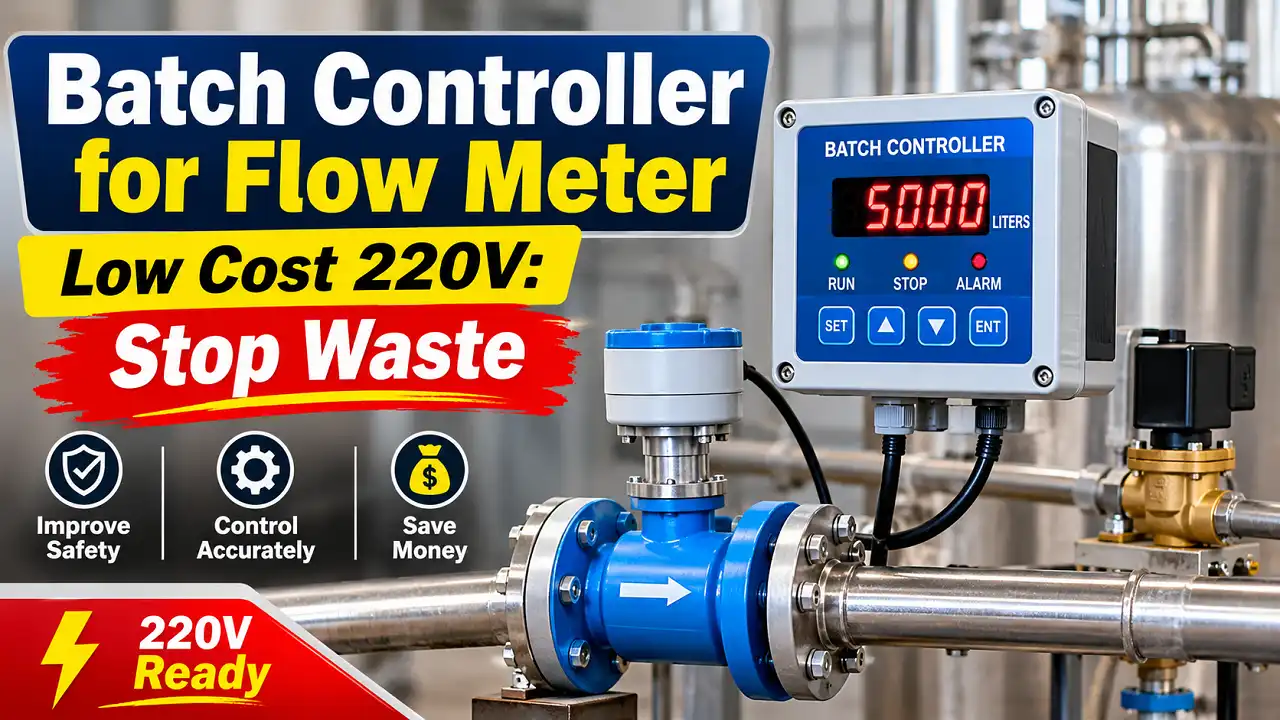
A batch controller that shuts off late can waste product on every fill. It can also overflow a tank or burn out a solenoid valve. Choosing a batch controller for flow meter low cost 220v setup looks simple online, but the cheapest box only stays cheap when the wiring, voltage and valve control are correct.
On recent service calls across Chattanooga, we have found the controller itself is rarely the problem. The circuit feeding it usually is.
Key Takeaways
- Check the power input first. Some popular “low-cost” controllers, like the FLOMEC EB40 and EB11, are DC-powered. They need a separate power supply or a different model before they can run on 220V/240V.
- US “220V” is really 240V split-phase. An imported controller wired for 220V L-N needs two hot legs, a double-pole disconnect and proper grounding when you install it in a US building.
- Match the stage count to your valve. Single-stage units work well for small fills. Dual-stage units slow the flow before shutoff to cut overrun on larger batches.
What Is a Batch Controller for a Flow Meter?
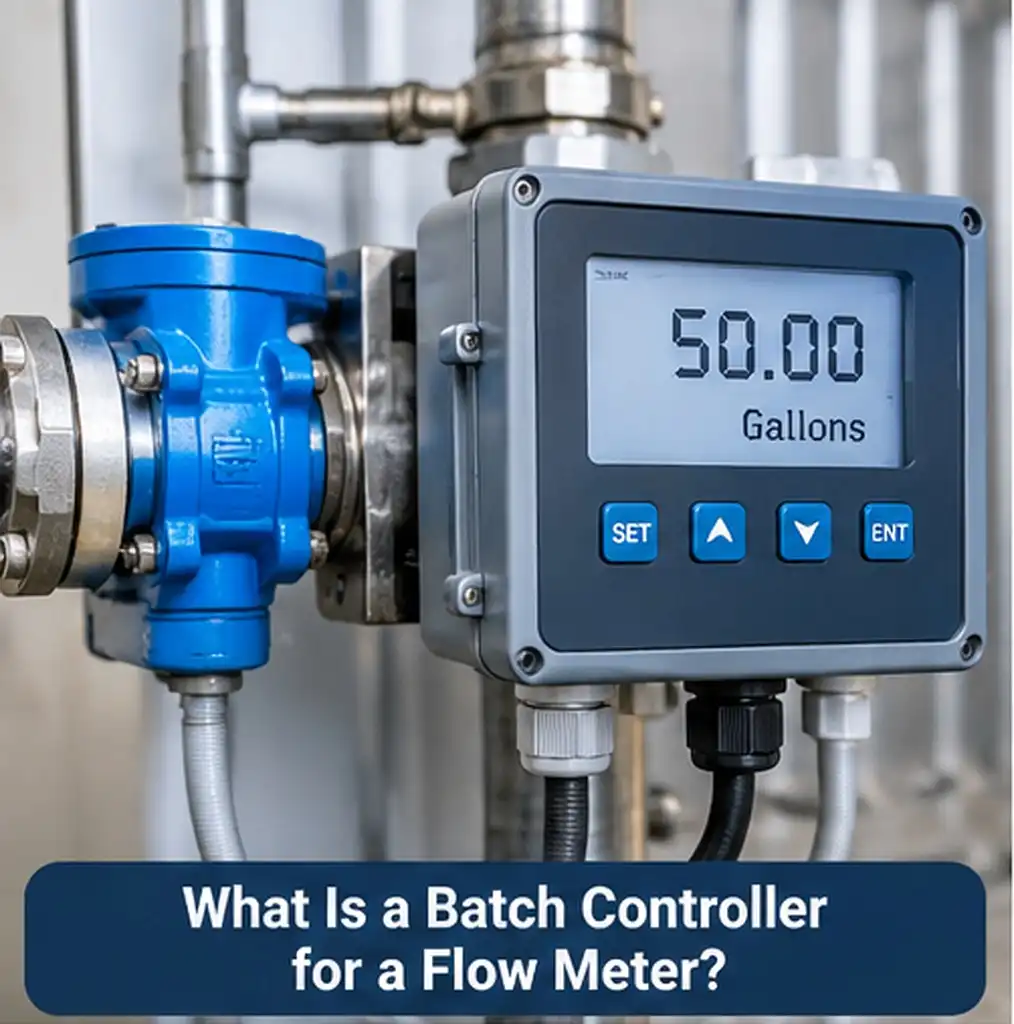
A batch controller dispenses a preset amount of liquid and then stops. It reads pulses from a flow meter, counts the volume and signals a valve or pump to close at the target. Distributors such as Mid-South Sales describe these units as instruments that pair with a flow sensor and control valve to fill a container, tank or vehicle.
How a Batch Cycle Works
- Enter the batch size. You set the target volume, such as 50 gallons.
- Press start. The controller opens the solenoid valve or starts the pump.
- Count the pulses. The flow meter sends pulse or 4-20 mA signals to the controller.
- Slow the flow (dual-stage only). A second relay drops to a slow fill near the target.
- Close the valve. The controller stops flow and records the batch total.
- Apply overrun compensation. Better units learn how much liquid passes after shutoff and close earlier next time.
Key Terms in Plain Language
| Term | What It Means |
|---|---|
| Pulse input | Electrical “ticks” from the meter. Each tick equals a set volume. |
| 4-20 mA input | An analog signal where 4 mA means zero flow and 20 mA means full flow. |
| K-factor | The number of pulses per gallon or liter. You enter it during setup. |
| Overrun | Liquid that keeps flowing after the valve gets the shutoff signal. |
| Relay output | A switch inside the controller that opens or closes the valve circuit. |
| NPN output | A transistor output for low-current solenoid control. It is not a power relay. |
| Totalizer | A running count of all liquid measured over time. |
| Modbus RTU / RS485 | A data link that sends readings to a PLC or computer. |
Get your meter’s K-factor before you buy anything. Without it, no controller can measure accurately.
Check Also: Lights Flicker When Appliance Turns On: What It Means
Where These Controllers Show Up Around Chattanooga

Batch controllers solve repeat-fill problems. Our certified electricians frequently see them in small operations across the region, not just large plants. If you’ve spent a summer in Chattanooga, you know heat and humidity punish outdoor control gear.
| Setting | Typical Liquid | Common Batch Job |
|---|---|---|
| Farms in the Sequatchie Valley | Water, fertilizer, sprayer mix | Filling spray tanks to the same volume |
| Shops and fleet yards | Diesel, DEF, oil | Dispensing a set amount per vehicle |
| Craft breweries and food makers | Water, syrups | Measured water additions per batch |
| Car washes and cleaning operations | Soap concentrate, water | Mixing chemical at a fixed ratio |
| Rural homes with wells | Water | Filling livestock tanks or storage |
Most of these sites already have 240V service for pumps or shop equipment. That makes a batch controller for flow meter low cost 220v model attractive, since the power is already nearby. Your next step is to find where that power comes from and how much capacity is left.
Check Also: Outlet Sparks When Plugging Something In: Chattanooga Fixes
How 220V Wiring Applies in US Buildings
US homes and small buildings do not have true 220V. They run on 120/240V split-phase power. You get 240V between two hot legs and 120V from either hot leg to neutral.
Many imported controllers are labeled “220V” because they come from markets with 220-230V single-phase power.
Voltage Options Compared
| Power Input | Where It Comes From | Works on US Power? | What to Check |
|---|---|---|---|
| 220V AC (L-N) | Imported models (e.g., Silver Instruments Coriolis batch wiring shows L, N, G terminals) | Yes, on 240V two-hot wiring, if the rating allows it | Voltage tolerance, 50/60 Hz rating |
| Universal AC (e.g., 85-265V) | Models such as Ashe MX-450 series | Yes, on 120V or 240V | Terminal labels and fuse rating |
| 120V AC | Many US-market controllers | Yes, on a standard circuit | Shared circuit load |
| DC (battery or 12-24V) | FLOMEC EB40 and EB11 “Easy Batch” | Only with a listed DC power supply | Supply size, relay voltage |
The Imported 220V Trap
Here is the problem we find most often. A controller marked “L” and “N” expects one hot wire and one neutral. On a US 240V circuit, the “N” terminal gets the second hot leg, not a neutral. Both wires carry voltage to ground.
That changes three things:
- Both conductors must be switched. Use a double-pole breaker and disconnect.
- The ground stays separate. The “G” terminal goes to the equipment grounding conductor, never to a hot leg.
- The voltage must fit. 240V is about 9% higher than 220V. Confirm the controller tolerates it.
A unit rated “220V only” with no tolerance range is a gamble on 240V. Ask the seller for the datasheet before you order. If you are unsure what your building has, an on-site electrical inspection shows the real voltage and panel condition.
Cost Comparison: Low-Cost vs Mid-Range vs Premium
Price depends on power type, stage count and outputs. The figures below come from published US distributor listings as of 2026.
Some brands sell by quote only, so we list them that way instead of guessing.
Controller Hardware Prices
| Model | Tier | Listed Price | Power Input | Stages | Valve Output | Notes |
|---|---|---|---|---|---|---|
| FLOMEC EB40 (EB406D0FM) | Low-cost | $446 | DC | Single | NPN (no relay) | Field mount, NEMA 4X/IP66/67 rated line |
| FLOMEC EB40 with 5A relay (EB406D0FM-R) | Low-cost | $522 | DC | Single | 5A mechanical relay | Better for direct solenoid switching |
| FLOMEC EB11 (EB112D0FM / EB112D0MM) | Mid-range | $844 | DC | Dual | NPN | Field mount or meter mount |
| Ashe MX-450 / MX-460 | Mid-range | Quote | Universal AC | Batch control via 2 relays | 2 change-over relays | 4-20 mA or 0-10 kHz pulse input, RS485 Modbus |
| Ashe MX-450W | Mid-range | Quote | Universal AC | Batch control | 2 relays | Weatherproof ABS wall-mount enclosure |
| Silver Instruments AJ-D Series | Low to mid | Quote | AC (check datasheet) | Batch control | Relay | Panel-meter style controller |
| GPI N410 2-Stage | Premium | $1,766 | Check datasheet | Dual | Relay | Ships in 1-2 days per GPI listing |
| Generic marketplace units | Lowest upfront | Varies widely | Often 220V AC | Varies | Varies | Certification and support often unclear |
What Lead Time Looks Like
| Model | Published Lead Time (GPI) |
|---|---|
| FLOMEC EB40 | 3-4 days |
| FLOMEC EB11 | 5-6 weeks |
| GPI N410 | 1-2 days |
Total Installed Cost: What Drives It
The controller is only one line on the bill. Wiring, disconnects and enclosures can add up fast.
| Cost Item | Low-Cost Path | Mid-Range Path | Premium Path |
|---|---|---|---|
| Controller | DC unit or generic 220V | Universal AC dual-relay unit | Two-stage branded unit |
| Power supply | Listed DC supply needed for DC units | Not needed | Depends on model |
| Circuit work | Tap existing circuit (if code allows) | New dedicated circuit | Dedicated circuit plus surge protection |
| Disconnect | Single-pole or double-pole switch | Double-pole fused disconnect | Lockable disconnect |
| Enclosure | Unit’s own housing | NEMA 4X box for outdoor use | Panel built to UL 508A |
| Permit and inspection | Often required | Often required | Required |
Our crews price this work line by line so you can compare quotes fairly. A cheap quote that skips the permit is not a real comparison. Start by listing the controller model, its power input and the valve you plan to switch.
Check Also: How a Chattanooga Electrician Protects Your Home & Wallet
Single-Stage vs Dual-Stage Batch Controllers
Stage count controls shutoff accuracy. A single-stage controller opens and closes one valve. A dual-stage controller adds a second, slower stage near the target.
| Feature | Single-Stage | Dual-Stage |
|---|---|---|
| Example models | FLOMEC EB40 | FLOMEC EB11, GPI N410 |
| Listed price | $446-$522 | $844-$1,766 |
| Valves needed | One | Two, or one two-speed valve |
| Shutoff method | Full flow to full stop | Slow fill before stop |
| Overrun | Higher at high flow rates | Lower |
| Water hammer risk | Higher with fast-closing valves | Lower |
| Best for | Small fills, low flow, simple setups | Large tanks, costly liquids, high flow |
| Wiring complexity | Simple | More relays and control wires |
Pick single-stage for small, slow fills. Pick dual-stage when overfills cost real money or flow rates are high. Write down your typical batch size and flow rate, then compare them against the controller’s spec sheet.
NEC and Safety Standards for 220V Controller Installs
Batch controllers fall under the same electrical rules as any fixed equipment. The National Electrical Code (NEC), also called NFPA 70, sets the baseline. You can review the code through the NFPA 70 standard page. Local jurisdictions adopt specific editions, so confirm the adopted edition with your permit office.
| Standard or Rule | What It Covers | Why It Matters for Batch Controllers |
|---|---|---|
| NEC 110.3(B) | Install listed equipment per its instructions | The controller’s manual sets wire sizes and fusing |
| NEC 110.26 | Working space around equipment | Keep clear access for service and resets |
| NEC Article 210 | Branch circuits, including GFCI rules in 210.8 | Outdoor and wet-area outlets often need GFCI |
| NEC Article 240 | Overcurrent protection | Breaker and fuse sizes must match the wire |
| NEC Article 250 | Grounding and bonding | The “G” terminal needs a true equipment ground |
| NEC Article 300 | Wiring methods | Conduit and cable must suit the location |
| NEC Article 409 | Industrial control panels | Applies when the controller sits in a built panel |
| NEC Article 430 | Motors and motor controls | Applies to the pump the controller starts |
| NEC power-limited circuit rules (Article 725 and related) | Low-voltage signal and control wiring | Separates meter signal wires from power wires |
| UL 508A | Industrial control panel construction | Shows a panel was built to a recognized standard |
| NEMA 4X / IP66 | Enclosure protection from water and corrosion | Needed for washdown or outdoor mounting |
| OSHA 1910.147 | Lockout/tagout | Protects workers during valve or pump service |
| Hazardous-location ratings | Flammable vapors, like fuel transfer | FLOMEC EB units are rated “Safe Area Only.” Use an explosion-proof unit, such as Ashe MX-450X, where required |
Fuel dispensing deserves extra care. A controller rated safe area only cannot sit inside a classified hazardous zone. Ask your electrician to confirm the area classification before mounting anything near diesel or gasoline transfer.
Installation Requirements for a 220V Controller Circuit
A clean install follows a set order. Our certified electricians use this sequence on every controller job.
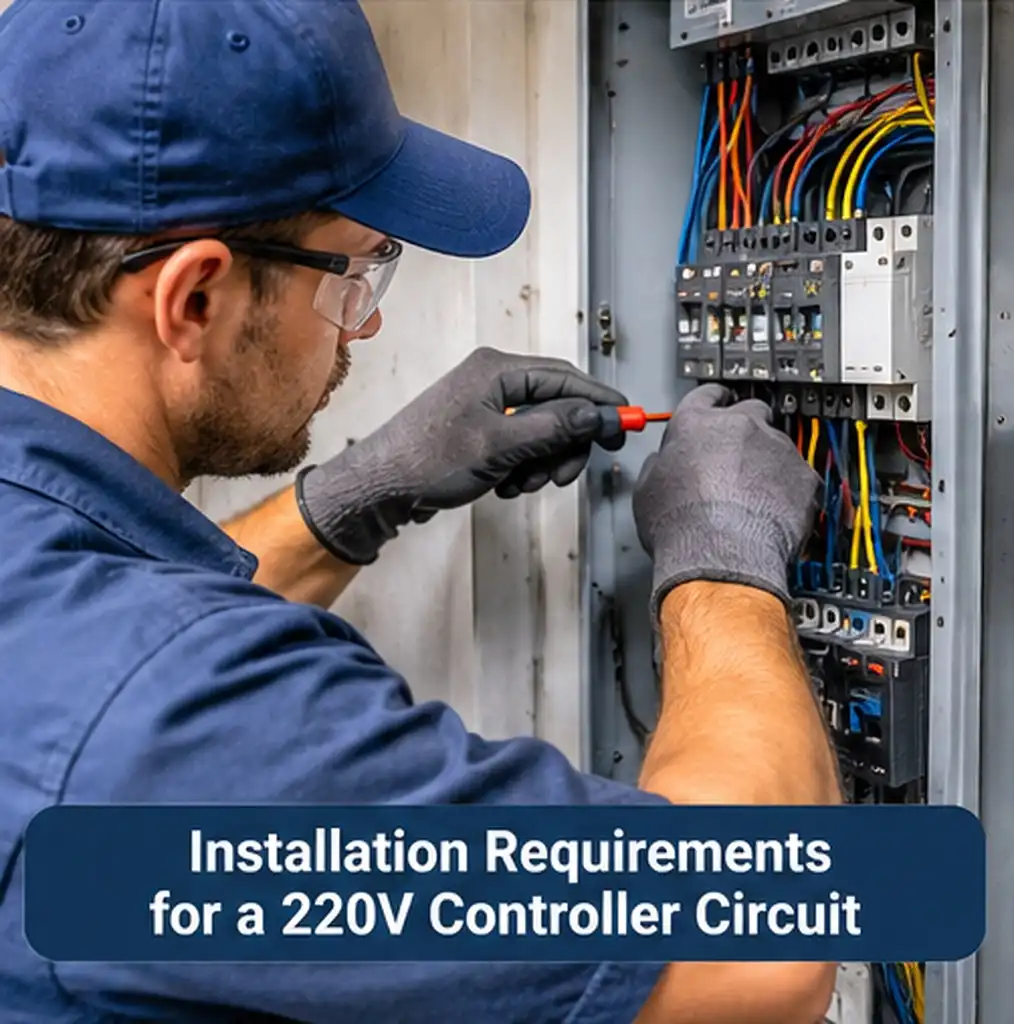
Step-by-Step Install Process
- Read the datasheet. Confirm voltage, frequency, current draw and relay ratings.
- Check panel capacity. Make sure the panel has room and load capacity for a new circuit. Crowded or worn panels may need panel repair or replacement first.
- Run a dedicated circuit. Keep the controller and pump off shared circuits. A dedicated circuit prevents nuisance resets when other loads start.
- Install a double-pole breaker. On 240V, both hot legs must open together.
- Add a local disconnect. Place a lockable disconnect within sight of the controller and pump.
- Bond the ground. Land the equipment grounding conductor on the “G” or PE terminal.
- Separate signal wiring. Run meter pulse cable in its own raceway, away from 240V conductors.
- Size the valve circuit. Check the solenoid coil voltage and inrush current against the relay rating.
- Add surge protection. Protect sensitive electronics from storm-driven spikes.
- Test and calibrate. Run a measured test batch and adjust the K-factor and overrun setting.
Relay and Valve Matching
| Valve Type | Coil Voltage | Controller Output Needed |
|---|---|---|
| Small 24V DC solenoid | 24V DC | NPN output or small relay |
| 120V AC solenoid | 120V AC | Mechanical relay rated for 120V AC |
| 240V AC solenoid | 240V AC | Mechanical relay rated for 250V AC |
| Motorized ball valve | Varies | Relay plus valve’s own power supply |
| Pump motor | 240V AC | Relay driving a motor contactor, not the motor directly |
Never switch a pump motor straight through a controller relay. A 5A relay will weld shut under motor inrush. Use the relay to energize a contactor sized for the motor.
Pre-Install Checklist
- Controller datasheet and wiring diagram on hand
- Flow meter K-factor recorded
- Valve coil voltage confirmed
- Panel space and load checked
- Mounting spot out of direct sun and rain spray
- Permit requirements confirmed with the city or county
Once this list is complete, you are ready to request an install quote with clear scope.
Chattanooga Climate Factors That Affect Controllers
Local weather shortens the life of cheap electronics. Our electrical crews notice the same failure patterns every year across the Tennessee Valley.
| Local Condition | Effect on Controller | Fix |
|---|---|---|
| Summer humidity | Condensation inside housings, corroded terminals | NEMA 4X enclosure, drip loops, sealed glands |
| Afternoon thunderstorms | Voltage spikes damage displays and inputs | Panel-level surge protection plus point-of-use protection |
| Direct sun on outdoor units | LCD fade, plastic housing cracks | Shade hood or north-facing mount |
| Winter freezes on the plateau | Frozen lines, false readings, cracked meters | Heat trace and insulated piping |
| Rural long service runs | Voltage sag during pump start | Proper wire sizing and load review |
Storm season is when bargain controllers fail first. A surge device costs far less than replacing a controller, a meter and a valve coil together.
Troubleshooting Checklist for Batch Controllers
Most controller “failures” trace back to power, signal or settings. Work through this list before you buy a replacement. If a step involves opening a powered enclosure, stop and call a licensed electrician.
Power problems
- Display is blank: check the breaker, disconnect and fuse first.
- Display flickers: look for loose terminals or voltage sag when the pump starts.
- Unit resets during batches: the circuit may be shared or overloaded.
Signal problems
- Count stays at zero: check the meter pulse wiring and sensor power.
- Count jumps randomly: signal cable may run beside 240V conductors, picking up noise.
- Total reads high or low: re-enter the K-factor and run a test batch.
Output problems
- Valve never opens: test the relay output and valve coil voltage.
- Valve never closes: the relay contacts may be welded shut.
- Overfills every batch: adjust overrun compensation or add a second stage.
Breaker problems
- Breaker trips at valve opening: suspect a shorted coil or undersized breaker.
- Breaker trips in rain: water is reaching a box, fitting or cable.
When the cause is not obvious, professional electrical troubleshooting traces faults with proper meters instead of guesswork.
Repair vs Replace: Making the Call
Some faults are cheap fixes. Others mean the controller is done.
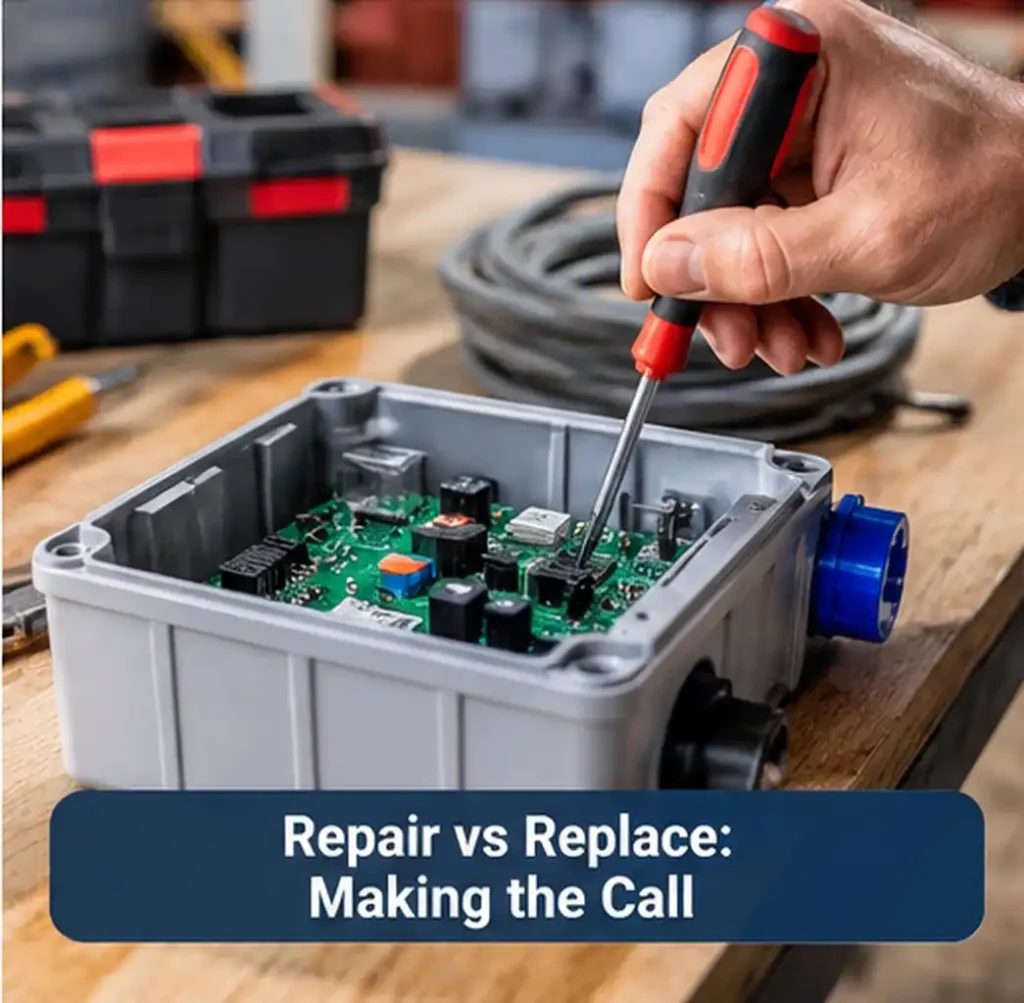
This table reflects what we see on real service calls.
| Symptom | Likely Cause | Repair or Replace? | Typical Lifespan Factor |
|---|---|---|---|
| Blank display, unit cool | Tripped breaker or blown fuse | Repair | No impact |
| Corroded terminals | Moisture entry | Repair and reseal | Shortens life if ignored |
| Wrong batch totals | K-factor or setup error | Repair (reprogram) | No impact |
| Welded relay contacts | Overloaded valve or motor circuit | Repair if relay is replaceable, else replace | Major |
| Cracked housing | Sun or impact damage | Replace in wet areas | Major |
| Dead after storm | Surge damage to board | Replace and add surge protection | Total loss |
| Faded or dead LCD | UV and heat exposure | Replace | End of life |
| Controller lacks needed output | Wrong model choice | Replace with correct model | Not a fault |
Here is a simple rule: if repair costs more than half a new unit, replace it. For generic imports with no parts support, replacement is often the only choice.
Pros and Cons of a Low-Cost 220V Batch Controller
A batch controller for flow meter low cost 220v purchase saves money upfront. The trade-offs show up in support, ratings and wiring work.
Pros
- Lower upfront cost than premium two-stage units
- Runs from existing 240V pump or shop circuits
- Many imported models include two relays and RS485 output
- Universal AC inputs on some models fit both 120V and 240V
- Fast payback when it stops overfills and manual errors
Cons
- Unclear certifications on many marketplace units
- 220V L-N labeling confuses US installs
- Short or no warranty support in the US
- Thin plastic housings may not survive outdoor humidity
- Manuals may be poorly translated, making setup errors common
Check for a recognized listing mark before you buy. Inspectors may flag unlisted equipment, which turns a cheap controller into an expensive redo.
Buying Checklist: Choosing a Controller in the USA
Shopping for a batch controller for flow meter low cost 220v usa delivery means comparing more than price.
Use this numbered list to narrow choices.
- Confirm the input signal. Match pulse, 4-20 mA or frequency to your meter.
- Confirm the power input. Look for a voltage range, not a single number.
- Confirm 60 Hz support. US power runs at 60 Hz, not 50 Hz.
- Count the relays. Two relays allow dual-stage control or an alarm.
- Check relay ratings. Compare amps and voltage to your valve coil.
- Check the enclosure rating. Choose NEMA 4X or IP66 for outdoor or washdown use.
- Check the hazard rating. Fuel areas may need explosion-proof construction.
- Ask about US support. Distributors like GPI and FLOMEC offer US sales and tech help.
- Read the wiring diagram. Make sure an electrician can follow it.
- Get the install quote first. Total cost includes circuit, disconnect and permit.
The best deal is the controller that passes inspection the first time. Send the datasheet to your electrician before checkout.
Maintenance Checklist for Long Controller Life
A few minutes of checks prevents most failures. Our certified electricians recommend this schedule for local properties.
Monthly
- Run a test batch into a measured container
- Compare the controller total to the actual volume
- Check the display for fading or flicker
- Look for moisture behind the display window
Quarterly
- Inspect cable glands and seals
- Check the valve for slow closing
- Clean the meter strainer, if your system has one
Yearly (with power off and locked out)
- Tighten power and relay terminals
- Inspect wiring for heat discoloration
- Verify the ground connection
- Recalibrate the K-factor
- Test the surge protective device status light
Scheduled electrical maintenance catches loose connections before they arc. For energy and pumping efficiency tips, the U.S. Department of Energy’s Energy Saver resources explain how better controls reduce wasted power and water.
Batch Controller for Flow Meter Low Cost 220V Chattanooga TN: Local Install Notes
Finding a batch controller for flow meter low cost 220v Chattanooga TN install often starts with the property’s power. Rural lots, barns and shops across the region frequently have older wiring or long service runs. A controller is only as reliable as the circuit behind it.
| Local Situation | What We Usually Find | Typical Fix |
|---|---|---|
| Barn or shop with one feeder | No spare capacity for new loads | Load review, possible service increase |
| Older home with small panel | No room for a double-pole breaker | Panel upgrade or subpanel |
| Well pump area | Wet location, no GFCI | GFCI protection and sealed boxes |
| Lake dock transfer pumps | Corrosion and bonding gaps | Wet-rated wiring and bonding |
When a property needs more capacity, an electrical service upgrade is based on a load calculation and coordinated with the power company. New runs to a pump house or shop fall under home wiring work, which covers new circuits and extended runs. If a controller circuit is already damaged, electrical repair gets it safe before you add anything new.
FAQs
Can I run a 220V batch controller on US 240V power?
Yes, if the controller’s rated range covers 240V and 60 Hz. Wire both hot legs through a double-pole breaker and keep the ground separate. Never land a hot leg on a ground terminal.
Are FLOMEC EB40 and EB11 controllers 220V models?
No. Both are listed as DC batch controllers. You need a listed DC power supply or a different AC-powered model to run from 240V.
What is the cheapest reliable batch controller for flow meter low cost 220v use?
The lowest published US price we found is the FLOMEC EB40 at $446, but it runs on DC. For direct AC power, universal-input models like the Ashe MX-450 sell by quote. Compare total installed cost, not just the box price.
Do I need a permit to install a batch controller?
A new circuit, disconnect or pump connection often needs a permit. Rules vary by city and county. Your electrician should confirm and pull any permit required.
Can the controller relay start my pump directly?
Only very small pumps within the relay’s rating. Most pumps need a motor contactor that the controller relay energizes. This protects the relay from motor inrush current.
Why does my controller overfill every batch?
Valve closing time lets extra liquid pass. Adjust the overrun compensation setting or move to a dual-stage controller. A slower final stage cuts overfill on larger batches.
Should I buy from Amazon, eBay or Alibaba?
You can, but check the listing marks, voltage range and frequency first. Ask for a full English wiring diagram. Without these, inspection and setup get harder.
Does a batch controller need surge protection?
Yes, especially in the Chattanooga area. Summer storms send spikes through power and signal wiring. Panel-level and point-of-use protection together give the best defense.
Get the Circuit Right Before the Controller Arrives
A batch controller for flow meter low cost 220v setup pays off only when the power, grounding and valve control are correct from day one. At Chattanooga TN Electrician, our focus is honest scope, clear pricing and code-compliant work. One call connects you with a licensed local electrician who can review your controller’s datasheet, check your panel and quote the full job.
Check whether we cover your town on our service areas page, then call (866) 228-4017 with your controller model and address ready.