
Lighting & Controls

Ceiling Fan Installation and Wiring in Chattanooga

Ceiling fan installation means mounting a fan securely and wiring it so it can be controlled the way you want. That may be replacing an existing light fixture with a fan, swapping an old fan for a new one, putting a fan in a room with no ceiling box at all, or adding a fan to a covered porch.

Your call connects you with an independent local electrician who serves your area.

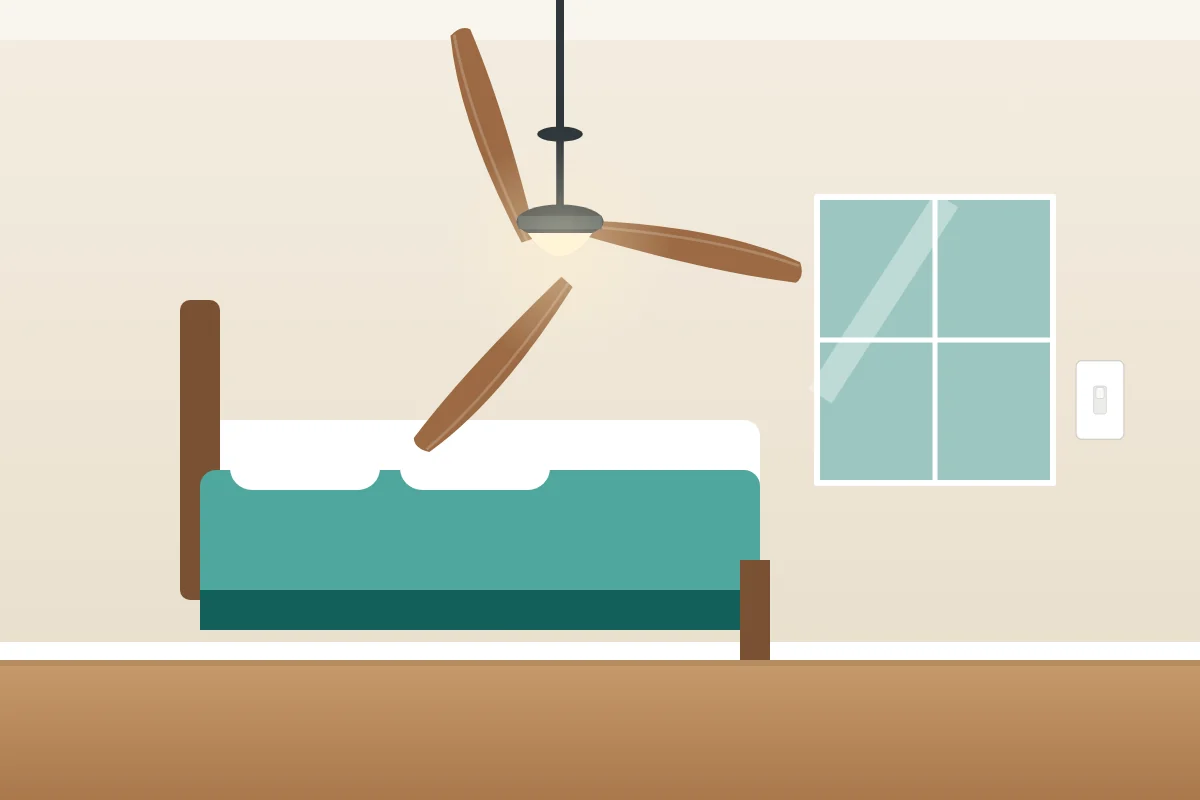
Illustration of a ceiling fan with a light kit in a bright bedroom

The part most people miss is support. A fan moves and vibrates, so it needs a box and brace rated for fan use, not a standard light box. A ceiling fan electrician in Chattanooga can confirm the mounting, sort out switching and handle tricky ceilings. A call connects you with an independent local electrician.

Mounting, Wiring and Controlling a Fan

Mounting comes first. If the existing box is not fan-rated, the electrician installs one, often with an expandable brace between joists that goes in through the existing ceiling opening. Sloped and vaulted ceilings need angle-compatible mounts and downrods long enough for proper blade clearance. Porches call for fans rated for damp or wet locations.

Wiring and control come next. With a single switch leg, the fan and light usually share one switch unless a remote or wall control is used. Separate wall control of fan and light typically needs an additional conductor between the switch and the ceiling, which may mean running new cable. Speed control must come from fan-rated wall controls; ordinary light dimmers should never run fan motors.

Typical Ceiling Fan Jobs

  1. Replacing a bedroom or living room light fixture with a fan and light

  2. Swapping an old wobbling or noisy fan for a new one

  3. Adding a fan to a room with no ceiling box

  4. Installing a fan on a vaulted or sloped ceiling

  5. Putting a damp- or wet-rated fan on a covered porch or screened deck

  6. Adding separate wall controls for the fan and light

Signs an Existing Fan Needs Attention

  • The fan wobbles noticeably or the mount moves when it runs
  • Humming, clicking or grinding that was not there before
  • The fan or its light flickers or stops intermittently
  • The breaker trips when the fan starts
  • Pull chains or the remote no longer control it properly

What the Electrician Will Confirm

Before the fan goes up, the electrician checks the box, the support above the ceiling, the switching and the condition of the wiring at the ceiling. In older homes, the box over an old light fixture is often too small or attached only to lath.

  • A fan-rated box secured to framing or a rated brace
  • Ceiling height and blade clearance, including downrod length
  • Number of conductors for separate fan and light control
  • Fan-rated speed controls rather than standard dimmers
  • Location rating for porch or outdoor fans
Illustration of a close-up of circuit breakers in a home panel with multimeter test leads
Illustration. People shown are not contractors listed on this site.

How it usually works

  1. Call and describe the room

    Mention the room, the ceiling height and type, and what is mounted there now. You will be connected with an independent local electrician.

  2. Check box and switching

    The electrician confirms the box rating, framing access and the wiring available at the switch.

  3. Mount and wire

    A fan-rated box and brace go in if needed, and any new cable for separate controls is run.

  4. Balance and test

    The fan is assembled, balanced and tested at every speed, with the light and controls checked.

For homes around Chattanooga

Chattanooga summers are hot and humid, so ceiling fans see heavy use, often running alongside the air conditioning for months at a time. Covered porches are common on older homes and on many newer ones, and those fans need moisture ratings. Plaster ceilings in older houses need extra care when a fan-rated box goes in.


Related problems

Problems that often lead to ceiling fan installation

  • Ceiling Fan Trips Breaker

    A fan that trips the breaker usually has a short in the fan, its light kit or the box wiring, or it is setting off an arc-fault breaker.

    Act promptly
  • New Ceiling Fan Has No Power

    A new fan that will not run is often a pull chain, wall switch or remote receiver setting, and sometimes a wiring mistake in the box.

    Usually not an emergency

Related services

Often planned alongside ceiling fan installation

Lighting & Controls

Indoor Lighting Installation

Adding new light fixtures, recessed lighting, pendants and switches where a room has too little light or none at all.

Lighting & Controls

Lighting Controls & Dimmers

Dimmers, three-way switches, timers, occupancy sensors and smart controls matched to the lights they actually run.

Lighting & Controls

Energy-Saving Electrical Upgrades

LED lighting, sensors, timers and properly sized circuits for efficient heat pumps and water heaters, planned room by room.

Lighting & Controls

Outdoor Lighting Installation

Porch lights, motion-sensing security lights, path lighting and landscape lighting wired to handle rain, heat and storms.

Service areas

Ceiling Fan Installation around Chattanooga

Homeowners from Soddy-Daisy to Ringgold call about ceiling fan installation. Calls go to participating independent electricians; pick your community for local context.

See every service area →

FAQ

Ceiling Fan Installation: common questions

Straight answers to the questions homeowners ask most about this topic.

Call Now

Often, yes, as long as the box is replaced or reinforced with one rated for fan support. The existing switch can usually control the new fan and light together. Separate control may need extra wiring between the switch and ceiling, or a remote.

Fan-rated boxes are usually marked inside, and they are securely fastened to framing or a rated brace. Many older boxes have no marking at all. An electrician can check without guessing, which is safer than finding out when a fan starts to wobble.

No. Ordinary light dimmers are not designed to control fan motors and can cause humming, overheating or motor damage. Use a fan speed control made for the purpose, or the fan's own remote or pull chains, to change speeds safely.

It depends on ceiling height and slope. The goal is enough blade clearance from the sloped ceiling and a safe height above the floor. Fan manufacturers list recommendations, and the electrician can confirm the right length and angled mount for your ceiling.

Yes. Fans on covered porches should be rated for damp locations at minimum, and those exposed to blowing rain need a wet-location rating. Indoor fans used outdoors can rust or fail early.

Only if the box and support can handle the new fan's weight and motion. Older installations sometimes relied on boxes that were marginal even for the original fan.

Call now

Ready to talk about ceiling fan installation?

One call connects you with a local electrician who can look at your home and explain your options.

Your call connects you with an independent local electrician who serves your area.